
The government will relocate 44 central administrative agencies that remain in the Seoul metropolitan area to Sejong from 2027 in stages. Major bodies including the Broadcast Media Communications Commission, the Personal Information Protection Commission and the Financial Services Commission are included in the move.
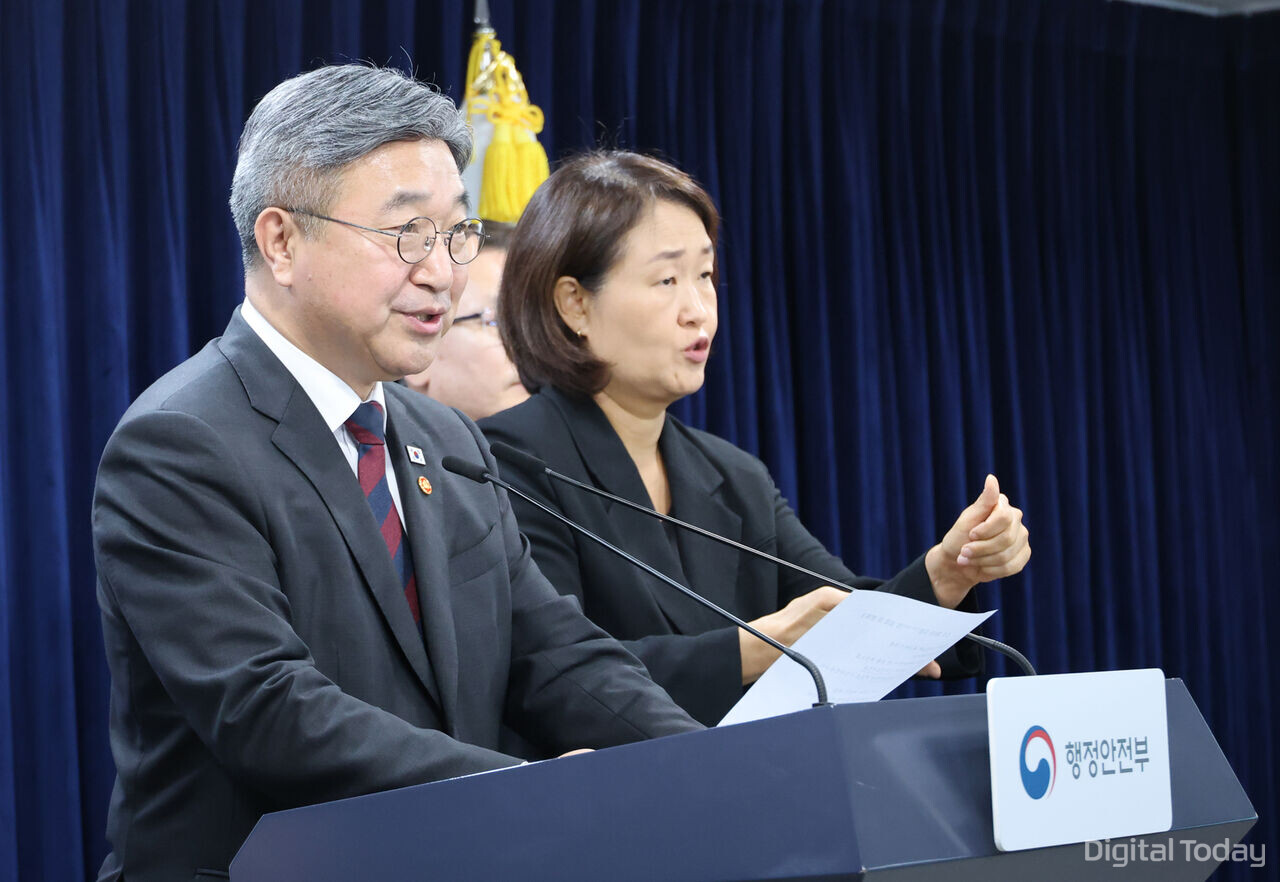
The Ministry of the Interior and Safety on Monday held a briefing at the Government Complex Seoul and announced a "second-phase plan to promote the relocation of central administrative agencies" containing those details.
A total of 44 agencies are slated to move, involving 9,929 officials based on staffing levels. The government reviewed 142 administrative agencies based in the metropolitan area and set the targets and methods for relocation in consideration of efficiency in state administration. Affiliated agencies that directly provide public-facing services were excluded.
The relocation will proceed in two tracks depending on each agency's work characteristics and the availability of office space: an early move using leased private offices and a move after construction of separate buildings.
First, 27 agencies with 2,995 staff were classified as moving by using leased private space in the Sejong area. Of these, 25 agencies that do not require legal revisions plan to complete relocation during 2027.
In the first half, the government will first push ahead with the relocation of six agencies: the Broadcast Media Communications Commission, the Personal Information Protection Commission, the Nuclear Safety and Security Commission, the National Human Rights Commission of Korea, the National Education Commission and the Overseas Koreans Agency.
The Broadcast Media Communications Commission will move its office from Gwacheon in Gyeonggi province to Sejong. The relocation covers 301 officials based on staffing levels. The Personal Information Protection Commission in Seoul will also be moved, covering 224 staff positions.
In the second half, the government will pursue the relocation of 19 agencies, including the Financial Services Commission as well as affiliated agencies and advisory committees of ministries. The Financial Services Commission has 340 staff positions, and the targets also include the National Artificial Intelligence Strategy Committee (35), the National Science and Technology Advisory Council (9), the National Bio Innovation Committee (22) and the National Economic Advisory Council (14).
On concerns that relocating the Financial Services Commission could weaken the government's ability to respond to financial markets, the government said it would prepare separate measures.
Kim Ha-kyun (김하균), head of the Government Buildings Management Headquarters at the Ministry of the Interior and Safety, said financial policy requires close coordination not only with institutions related to financial markets but also consultations and adjustments among relevant ministries. He explained that the government judged it did not necessarily have to remain in Seoul to strengthen financial policy.
He said the government would also prepare separate measures during the process of drawing up detailed relocation plans so it can maintain and strengthen its ability to respond to financial markets. He explained that whether to relocate financial institutions such as the Financial Supervisory Service is being reviewed separately along with the issue of relocating public institutions.
The Justice Ministry and the Ministry of Gender Equality and Family plan to decide the timing of relocation in line with the timing of revisions to the Special Act on the Construction of Administrative City in the Yeongi and Gongju Area for Follow-up Measures for a New Administrative Capital (Happy City Act).
The remaining 17 agencies requiring standalone buildings and special facilities, involving 6,934 staff, will relocate sequentially by 2031 after separate buildings are constructed.
They include foreign affairs and security ministries such as the foreign ministry, the unification ministry and the defence ministry, and investigation and judicial bodies such as the Board of Audit and Inspection, the National Police Agency, the Public Prosecution Office, the Serious Crimes Investigation Office and the Corruption Investigation Office for High-ranking Officials. The government cited the need to provide facilities suited to work characteristics such as investigation, security and control operations.
Relocation of presidential-affiliated bodies such as the Office of the President and the National Security Office will be reviewed separately, taking into account the timing of a full move of the president's Sejong office. Whether to relocate constitutional institutions such as the Supreme Court and the Constitutional Court was also not included in the plan.
The government will also pursue office space and budget needed for the relocation. It estimated costs of about 89.7 billion won for leased-office relocation in 2027, including lease, setup and operating expenses and relocation support for civil servants.
It estimated about 3.1 trillion won would be needed to build separate buildings. It plans to begin construction procedures by reflecting about 28.6 billion won in basic design costs next year. Additional costs are also expected from using leased offices until new buildings are completed.
The foreign ministry, unification ministry, defence ministry, justice ministry and the Ministry of Gender Equality and Family are designated as agencies excluded from relocation under the current Happy City Act, requiring legal revisions. The government plans to consult with the National Assembly on revising related laws and securing the budget.
Relocating civil servants will receive moving expenses and initial settlement support. The government will also consider temporarily providing transportation support in cases where immediate relocation is difficult due to arranging housing or waiting for the end of a child's school term. The specific scale and duration of support will be decided through consultations among relevant agencies.
The government will also prepare plans to use existing government complexes. It has begun research on mid- to long-term plans for the Government Complex Gwacheon and the Government Complex Seoul, and is reviewing ways to fill vacant space created by the relocation with special administrative agencies for the metropolitan area or institutions leasing private office buildings.
The ministry plans to revise and issue the central administrative agencies relocation plan after consultations with related agencies and public hearings, and to proceed with relocations depending on each agency's progress in securing office space. It will also draw up measures to ensure continuity of work at each agency so there are no gaps in administrative services such as civil complaints and licensing.
Yoon Ho-jung (윤호중), minister of the interior and safety, said the relocation of central administrative agencies is not simply about moving government space. He called it a spatial strategy to overcome a single-pole concentration in the capital region and use the national territory in a balanced way, and a growth strategy that leads South Korea's sustainable future and a new leap forward.
He said the government would strengthen Sejong's function as an administrative capital by pursuing agency relocation and improvements in work methods together while minimising inconvenience to the public.
 Seul-gi Son
sageson@d-today.co.kr
Seul-gi Son
sageson@d-today.co.kr