
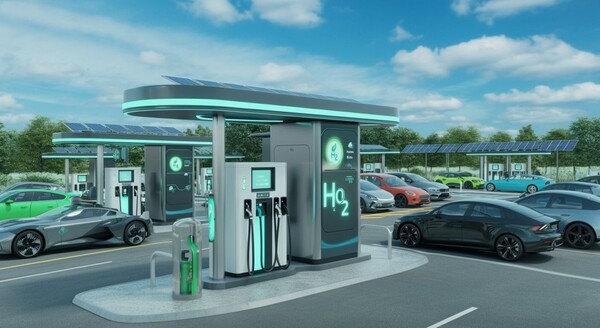
Europe is expanding charging infrastructure before hydrogen truck demand is sufficiently formed, and should review investment speed and business viability by taking lessons from Korea, an observation said. It said that even if stations are built first, if the number of vehicles using them does not increase enough, operating losses may have to be covered by government support.
On Oct. 13, electric vehicle-focused media outlet Cleantechnica analysed Europe’s policy to expand hydrogen charging infrastructure and presented Korea’s operating status as a key case. Under the European Union’s Alternative Fuels Infrastructure Regulation (AFIR), the EU plans to install hydrogen refuelling stations at intervals of no more than 200 km on core sections of the Trans-European Transport Network (TEN-T) by 2030, and to set up charging facilities at designated urban hubs. The capital investment needed to build a compliant network is estimated at about 2.1 billion euros (3.15 trillion won).
Korea has been shown to be slower to deploy vehicles than the pace of building hydrogen charging infrastructure. As of August 2026, Korea had 493 hydrogen refuelling facilities, reaching 74.7 percent of the 2030 target of at least 660. By contrast, the number of hydrogen vehicles deployed fell far short of the government target of 300,000. Korean government data put cumulative hydrogen vehicle deployment at 49,722 at the same point, about 16.6 percent of the target.
The profitability of operating stations is also cited as a challenge. Of 258 commercially operated refuelling stations assessed in the first half of 2026, 208 were reported to have received government support to offset operating losses. That accounted for 80.6 percent of the total. Some relatively recently opened stations were also found to have suspended operations due to worsening business prospects or financial losses. Still, it cannot be concluded that all stations that did not receive government support are operating at a profit.
The conditions under which hydrogen refuelling stations can make money vary depending on how stably demand is secured. The Jeonju Pyeonghwa station reported reaching break-even in 2024 in an environment where demand for hydrogen buses is concentrated. However, subsidies were put into building the station, and it is unclear whether depreciation of initial investment costs was reflected in the break-even calculation. The hydrogen supplied was also produced based on fossil fuels. That means it is difficult to evaluate bus-centred stations, where routes are fixed and fuel consumption is easier to predict, by the same standards as highway stations, where demand is uncertain.
Cost differences depending on how hydrogen is produced also affect business viability. Korea’s hydrogen refuelling business has relied heavily on relatively cheap fossil fuel-based hydrogen and by-product hydrogen generated in petrochemical processes. Hydrogen produced with renewable energy is advantageous for reducing greenhouse gas emissions, but higher production costs could also weigh on the economics of operating refuelling stations. Europe also faces the task of reducing emissions in the hydrogen production process while bearing transport, compression and refuelling costs.
The spread of battery electric trucks and the expansion of high-output charging infrastructure for large electric vehicles could also affect potential demand for hydrogen refuelling stations. If more vehicles shift to electric trucks, the customer base that hydrogen refuelling stations can secure may shrink.
Europe should not take expansion of refuelling networks for granted. It needs to verify, for each new facility, expected refuelling volumes, total capital and operating costs, the amount of public support required, hydrogen prices and production methods, and the actual greenhouse gas reduction effects. The Korean case shows that building infrastructure itself does not necessarily mean the formation of a sustainable market.
 Seungah Yoo
ysah@d-today.co.kr
Seungah Yoo
ysah@d-today.co.kr