
The government will build a support system that links physical AI technology development, industrial field demonstrations and private investment. It is responding to concerns that robot technology development takes a long time while private investment is fragmented by growth stage. The government plans to put fiscal resources into core technologies and training infrastructure, and use the National Growth Fund to support companies' commercialisation and large-scale equipment investment.
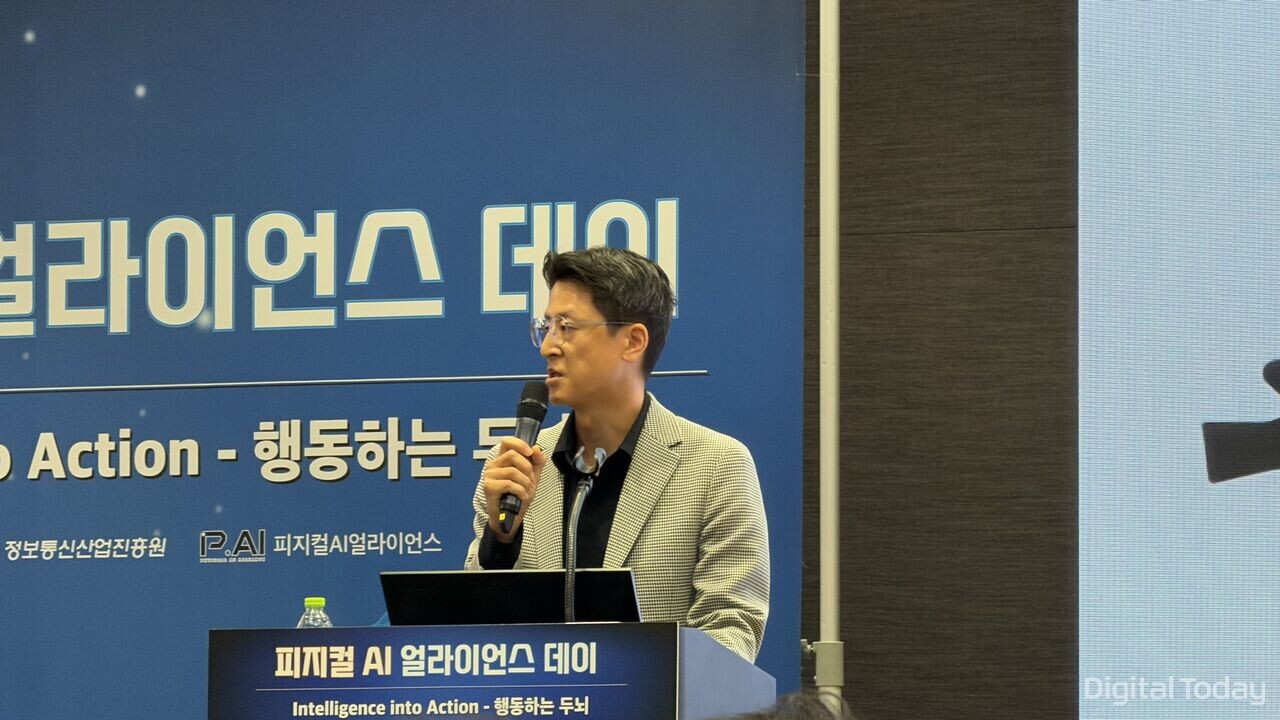
The Ministry of Science and ICT on Monday held a briefing on a cross-government physical AI programme for 2027 at Physical AI Tech Week in Seoul and disclosed support projects by relevant ministries and investment measures.
The government budgeted a total of 3.1 trillion won for the physical AI sector next year, more than tripling from 900 billion won this year. At the briefing, the science ministry and the Ministry of SMEs and Startups introduced details and schedules for new projects, while the Financial Services Commission presented plans to use the National Growth Fund.
FINANCIAL SERVICES COMMISSION TO EXPAND LONG-TERM INVESTMENT IN PHYSICAL AI; COMPANIES CAN APPLY DIRECTLY
The Financial Services Commission will strengthen an investment system to provide funding over a long period from technology development to commercialisation to foster the physical AI industry.
Kim Ki-hong (김기홍), director of the Advanced Industries 2 Division at the commission's National Growth Fund task force, diagnosed that South Korea's advanced industries have strong technological competitiveness but face difficulties entering global markets and scaling up due to a lack of private investment.
Industries such as physical AI, which require large amounts of capital and long periods for technology development, demonstrations and building mass-production facilities, have limits to growth with existing private investment alone, he said. To address this, the commission will pursue long-term investment using the National Growth Fund and expand funding across the industrial ecosystem.
The National Growth Fund is a policy finance programme that will supply a total of 150 trillion won over the next 5 years by combining 75 trillion won from the Advanced Strategic Industries Fund with 75 trillion won from private financial institutions and other sources. The government is pursuing a plan to raise annual supply to at least 40 trillion won and expand the overall operating scale to more than 200 trillion won.
The commission plans to provide patient capital needed for technology development through the National Growth Fund's indirect investment programme, the Ultra-Long-Term Technology Investment Fund. The fund, which the government is seeking to set up at 880 billion won this year, is designed to be operated for up to 16 years including any extension period.
Funding will be divided into direct investment, indirect investment, infrastructure finance and investment, and ultra-low-interest loans. The approach supplies funds not only for equity investment tailored to the growth stage of technology firms but also for building large-scale infrastructure such as production facilities and data centres.
The commission will, in particular, identify large investment demand centred on three mega projects: semiconductors, physical AI and AI data centres. It plans to link research and development and demonstration projects by relevant ministries with financial support.
Support will not be limited to companies that directly develop AI models or robots. The scope will also include companies that supply equipment or build facilities needed for production and operation by advanced strategic industry companies, firms investing in related technology development, and demand companies that purchase produced products.
The National Growth Fund is operated by the Korea Development Bank. Companies can check eligibility and procedures on the National Growth Fund website and apply for investment and loan support. The commission also operates a Growth Company Discovery Council through which government ministries, local governments and financial institutions recommend promising projects.
Companies can also directly propose projects to the council. Proposed projects will be reviewed for ripple effects on the industrial ecosystem, growth potential and policy necessity, and support will be decided after the development bank's screening and deliberation by relevant committees.
Kim said the government would actively support technology development and commercialisation, and entry into global markets, by strengthening links among ministries. He added it would work to ensure investment is made evenly from long-term technology development through commercialisation.
SCIENCE MINISTRY TO COVER ROBOT INTELLIGENCE DEVELOPMENT THROUGH TRAINING DATA AND LOGISTICS TRIALS
The Ministry of Science and ICT plans to invest a total of 121 billion won next year in three new projects covering physical AI core technology development, training infrastructure and logistics demonstrations.
The Institute for Information and Communications Technology Planning and Evaluation (IITP) will 추진 a 55 billion won project to develop physical AI core technologies. The aim is to secure a general-purpose physical AI foundation model that can judge and perform tasks on its own in various environments beyond the limited repetitive tasks of existing robots.
Kim Wook (김욱), physical AI programme manager at IITP, said the goal was not to perform simple tasks but to complete autonomous missions. He said the plan is to secure the ability to adapt to new tasks and environments and to plan and carry out multiple tasks in sequence.
The plan also calls for building a virtuous cycle in which data generated by robots working at real sites is fed back into AI model training. The approach is intended to raise robot work capability as model performance improves.
IITP plans to design detailed projects by year-end, hold a public hearing in November and announce tasks in January next year. It plans to conduct selection evaluations in March.
The National IT Industry Promotion Agency (NIPA) will invest 26 billion won in a physical AI demonstration and diffusion project and 40 billion won in a training centre construction project.
Yoo Han-jong (유한종), head of NIPA's Physical AI Team, presented a goal of applying physical AI to public logistics sites through the demonstration and diffusion project and spreading verified technologies to the private sector.
The core of the demonstration and diffusion project is applying physical AI technology to logistics processes at the Korea Post. While existing automated facilities focus on handling standardised mail items, the project aims to use physical AI to handle irregular mail items of varying shapes and materials.
It plans to support about 2 consortia involving AI model and data-related companies and the Korea Post. It will seek to issue a notice in March next year.
The training centre project will build a teleoperation-based training environment for remotely operating robots and support companies in generating, training and verifying behavioural data using real robots.
The aim is to address the difficulty for individual companies to build large-scale training facilities on their own and to help secure data needed for physical AI development through shared training infrastructure. NIPA plans to issue a project notice in March next year, conduct evaluations in April and start building the centre.
SMES MINISTRY TO APPLY PHYSICAL AI TO SMALL MANUFACTURING SITES; UP TO 4.5 BILLION WON IN SUPPORT
The Ministry of SMEs and Startups will newly 추진 a 172.8 billion won project next year to support physical AI demonstrations for small manufacturers. It plans to投入 a total of 440 billion won in state funds over the next 3 years.
While the existing smart factory project focused on digitising and automating production facilities, the new project will focus on deploying AI robots directly at manufacturing sites to improve irregular tasks and dangerous processes.
The project consists of four areas: general process demonstrations, hazardous process demonstrations, technology demonstrations and integrated demonstrations.
General process demonstrations will introduce physical AI to manual work-centred processes to address labour shortages at small manufacturers. It will provide up to 1 billion won in state funds for up to 2 years, with the state funding share capped at 70 percent.
Hazardous process demonstrations will apply AI robots at manufacturing sites with high risks of safety accidents and industrial disasters. It will provide up to 2 billion won for up to 2 years, with the state funding share capped at 70 percent.
Technology demonstrations will be carried out through cooperation among AI and robot companies and manufacturers to verify the feasibility of on-site application. Depending on the type of demonstration, it will provide 200 million to 400 million won in state funds for 1 year.
Integrated demonstrations will combine individual technologies to build AI-based manufacturing plants. After prior design and verification, it will select strong tasks and provide up to 4.5 billion won by supporting 1.5 billion won a year for 3 years in the main construction stage.
The ministry plans to use the project to secure cases that go beyond demonstrations of individual robot technologies and apply physical AI to entire manufacturing plants.
EXPANSION TO AGRICULTURE AND PORTS; CROSS-GOVERNMENT DEMONSTRATION SYSTEM
Other ministries will also 추진 physical AI projects tailored to the characteristics of each industry.
The Ministry of Agriculture, Food and Rural Affairs is preparing a project to develop Korean-style unmanned autonomous agricultural production technology with an investment of about 75 billion won over 5 years.
Kim Yong-joo (김용주), a project director at the Korea Institute of Planning and Evaluation for Technology in Food, Agriculture and Forestry, presented as development tasks the fact that agriculture is heavily affected by irregular environments such as soil and that many tasks rely on skilled workers' experience. The government plans to secure agricultural work data and link AI models with autonomous agricultural machinery to develop an autonomous production system spanning cultivation through harvesting.
The Ministry of Oceans and Fisheries will 추진 new projects such as autonomy for port cranes and transport equipment and optimisation of port operations based on agent AI.
Park Yong-hyeon (박용현), head of the marine and port team at the Korea Institute of Marine Science and Technology Promotion, explained that some tasks require remote control or manual intervention even at existing automated ports. He introduced plans to develop technologies for full-range autonomy of port equipment and intelligent operation systems.
The government plans to link technology development and field demonstrations that are dispersed among ministries and use policy finance such as the National Growth Fund to build a support system that leads to private-sector commercialisation.
 Seulgi Son
sageson@d-today.co.kr
Seulgi Son
sageson@d-today.co.kr