
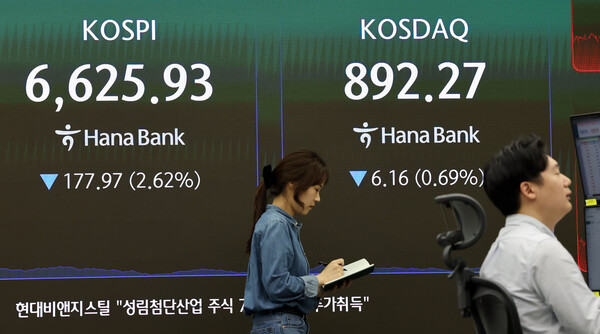
South Korean stocks are expected to look for direction this week as investors check U.S. inflation data and results from global semiconductor companies. Samsung Electronics shares slipped despite record-level results, making profit outlooks and interest-rate trends more important than headline numbers.
The Korea Exchange said the KOSPI fell 2.9 percent last week, while the KOSDAQ rose 0.6 percent. Media, cosmetics and apparel, and consumer IT were relatively strong, but large-cap leaders such as semiconductors and autos were weak.
Samsung Electronics in particular reported third-quarter operating profit of 10.7 trillion won, beating market expectations, but its shares fell. The move was seen as driven by profit-taking after funds positioned for strong results, foreign selling and valuation 부담 from high rates.
The industry sees next year’s outlook as more important than third-quarter results. With earnings at Samsung Electronics and other chipmakers already having improved sharply, the market has entered a stage of looking for further growth drivers, including expanded supply of high-bandwidth memory (HBM), memory prices and 2027 profit forecasts, the explanation said.
Lower market expectations after Samsung Electronics’ third-quarter results are also cited as a factor that could limit further declines. Recent operating profit forecasts have fallen significantly from their peak, and the price-to-earnings ratio (PER) remains at a historically low level. That suggests a substantial part of earnings uncertainty has already been priced in.
The first variable this week is the U.S. September consumer price index (CPI) and producer price index (PPI). With international oil prices and U.S. long-term yields staying elevated and inflation concerns rising again, whether inflation cools is important.
The market is focusing on the possibility that the month-on-month rise in core CPI will slow from August. If easing inflation is confirmed, concerns over additional tightening could ease and U.S. Treasury yields may stabilise.
If inflation comes in higher than expected, rate 부담 could rise again and weigh on semiconductors and growth stocks.
Third-quarter results from global semiconductor companies also need attention. ASML and TSMC report this week. The market is expected to focus less on revenue and profit figures and more on semiconductor equipment orders, artificial intelligence-related demand and capital spending plans.
If ASML and TSMC present solid results and forward guidance, domestic semiconductor investment sentiment, which has been shaken despite Samsung Electronics’ strong results, could revive.
If continued expansion of AI data centre and advanced process investment is confirmed, it is expected to support next year’s profit outlook for Samsung Electronics and SK Hynix.
If share price reactions remain muted even on strong results, the market may remain in a phase of weighing outlooks rather than numbers for the time being.
At high interest rates, the present value of future profits falls. Even with improved results, it is hard for shares to rise immediately if companies fail to show further growth potential.
Looking at the fourth quarter overall, share direction is likely to depend more on the pace of profit growth than its scale. Even in sectors that saw a large profit growth rate this year, share momentum could weaken if next year’s growth pace slows sharply. Sectors that maintain high profit growth next year could emerge as new market leaders.
Ultimately, this week’s market hinges on whether U.S. inflation data can reduce rate 부담 and whether ASML and TSMC can raise confidence in the semiconductor cycle again. If both conditions are met, the KOSPI, which has recently lost the 7,000 level, could try to rebound.
If inflation and rate 부담 persist and semiconductor companies’ forward guidance also falls short of expectations, differentiation by sector and stock is likely to intensify more than index moves.
Lee Kyung-min (이경민), an analyst at Daishin Securities, said, “Lower expectations have largely priced in concerns about earnings instability.” He added, “If easing inflation is confirmed in September CPI and an HBM4 ramp-up is confirmed in Samsung Electronics’ results, it could lead a recovery in semiconductor leadership and drive a further levelling up of the KOSPI.”
Lee Jae-man (이재만), an analyst at Hana Securities, said, “In a phase where profit growth rates are slowing, the level of the growth rate can have a bigger impact on share returns than the absolute size of profits.” He added, “There needs to be interest in sectors where high profit growth is expected even in 2027.”
 Oh Sang-yup
yub@d-today.co.kr
Oh Sang-yup
yub@d-today.co.kr