
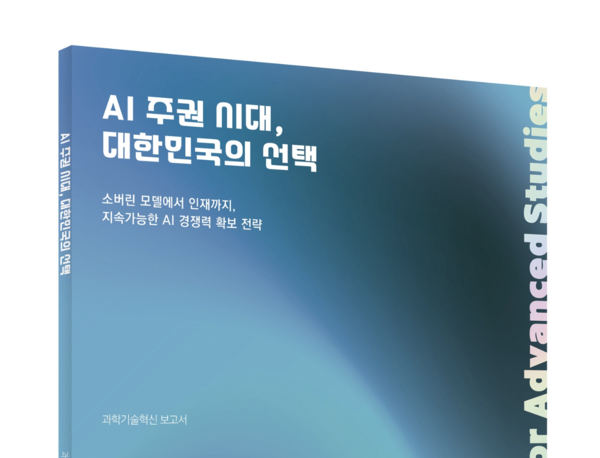
A strategy is needed to deliver immediate results with specialised AI and then link them to general-purpose AI capabilities, an argument said to have emerged. Choi Jong-hyun Academy said on Tuesday it published a report titled "In the age of AI sovereignty, South Korea's choice" and urged viewing sovereign AI as a strategic choice that distinguishes areas the state should control from those where global cooperation can be leveraged, rather than approaching it as a "domestic versus global" binary.
The report presented linkage, not selection, as the solution to conflict between general-purpose and specialised AI. It said short-term results and long-term capabilities should not be separated, but woven into a single strategic flow.
The report said debate over general-purpose and specialised AI is a matter of choice that divides the direction of industry and national strategy. Advocates of general-purpose AI see all vertical models as ultimately being integrated into large language models. It said function-by-function models such as image generation, video generation and music composition developed in parallel in the past, but recently these functions have been rapidly converging into a single LLM.
In response, supporters of specialised AI argue that specialised AI developed across fields such as healthcare, finance, manufacturing, autonomous driving and defence has evolved not into "intelligence that can do anything" but into "intelligence that does not get wrong problems that must be right". The market is also valuing this. As an example, Palantir, an AI company specialised in national security and strategic analysis, is drawing market attention alongside rapid growth.
The report pointed to manufacturing as the area where this structural tension appears most clearly. It described manufacturing as linked directly to exports, employment, technology and supply chains beyond a single industry, and said the choice of AI strategy is a key channel through which effects spread beyond industry to overall national competitiveness.
The report said that to pursue general-purpose manufacturing AI, a prerequisite is building an institutional "public pathway" that overcomes the fragmentation of manufacturing data scattered across individual companies. It said such cooperation does not arise naturally through technology alone, meaning it requires public infrastructure, data governance and a social consensus on sharing costs and responsibilities.
◆"The state is not the主体 of collection" A role in creating a public forum must come first
It also said the accumulation of tacit knowledge in the field is not a matter of individual companies' technological capability or will, but a matter of social consensus and institutional design. It explained that field knowledge is not data that can be gathered simply by demanding that it be "provided". The state is not the主体 of collection but should create a public forum, clearly prohibit data use for surveillance and evaluation purposes, and establish institutional safeguards so that workers' rights and safety are not infringed.
Above all, it said creating an environment where knowledge and experience can accumulate without fear of disadvantage is the minimum condition for general-purpose manufacturing AI to start from reality.
The report also stressed that debate over sovereign AI should move away from an approach that simplifies it into a pro-and-con structure. It said open source appears to be a neutral and open alternative, but in practice it can become a strategic tool that global big tech uses to expand market dominance.
It described a method in which long-term free provision exhausts competitors, secures dominance and later recoups profits. It warned that under the U.S. Clarifying Lawful Overseas Use of Data Act, or CLOUD Act, the U.S. government can exercise access rights even to data stored in overseas data centres operated by U.S. companies.
Kim Yooseok, head of Choi Jong-hyun Academy, said, "AI sovereignty is not a declaration that we will make everything ourselves, but a strategic decision about how to set the boundary between areas the nation must control and areas where global cooperation can be used." He added, "What is needed now is to set clearly the direction, namely national-level goals and the scope of responsibility, as much as the speed of technological competition."
The report was written based on discussions by a future science and technology small group involving AI specialist members of Choi Jong-hyun Academy's Science and Technology Innovation Committee and 12 external experts.
Participants from academia included Kim Gi-eung, a chair professor at KAIST's Department of Computer Science and the Kim Jaechul Graduate School of AI; Seo Youngju, a professor in POSTECH's Department of Computer Science and Engineering and head of the AI Research Institute; Jung Song, a chair professor of ICT at KAIST and dean of the Kim Jaechul Graduate School of AI; and Cha Sang-kyun, a distinguished fellow at Stanford University's Human-Centered AI Institute (HAI).
Participants from industry included Kim Yoon, chief strategy officer at TwelveLabs; Kim Jiwon, head of SK Telecom's AI Model Research Lab; Park Sunghyun, head of Rebellions; and Seong Nakho, head of hyperscale AI technology at Naver Cloud. Chey Tae-won, chairman of SK Group and chairman of the board of Choi Jong-hyun Academy, also took part and led discussions on industrial strategy and the social implications surrounding AI sovereignty.
 Daegeon Seok
d2dg@d-today.co.kr
Daegeon Seok
d2dg@d-today.co.kr