
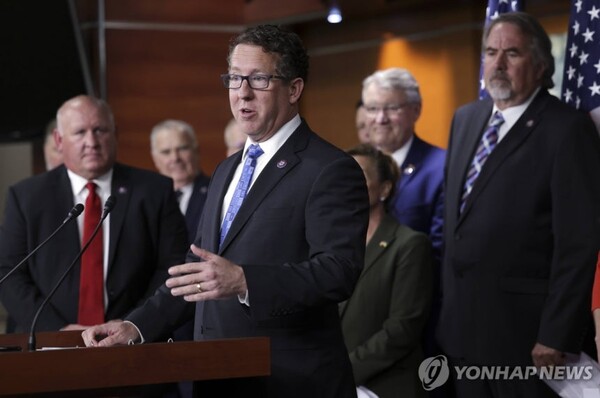
In the U.S. federal Congress, criticism has been raised publicly that South Korea's digital regulations and its efforts to hold Coupang to account amount to "discrimination against U.S. companies". South Korea sent a vice-minister-level official to explain the policies, but the mood suggests perceptions in U.S. political circles are not easily changing.
At a hearing of the House Ways and Means trade subcommittee in Washington on Jan. 13 local time, Chairman Adrian Smith, a Republican from Nebraska, said, "Korea continues to push legislative efforts clearly aimed at U.S. companies". He argued this runs counter to U.S.-South Korea trade agreements.
Smith pointed to Coupang in particular, saying South Korean regulators are aggressively targeting U.S. technology leaders. He characterised South Korea's government and parliamentary efforts to hold the company to account over a personal data leak as "discriminatory regulation".
Coupang is a South Korean subsidiary of Coupang Inc., which is listed on the New York Stock Exchange, and the parent company holds a 100 percent stake. More than 70 percent of voting rights are held by founder Kim Beom-seok, chairman of Coupang Inc.'s board, and Kim is a U.S. citizen.
The hearing was held as Trade Minister Yeo Han-koo was visiting the United States to address concerns in the U.S. government and political circles over South Korea's digital regulations. Yeo met U.S. Representative Darrell Issa, a Republican from California, and others the previous day and explained that South Korea's digital regulations do not target any specific country or company.
But the response in U.S. political circles was cold. U.S. Representative Carol Miller, a Republican from West Virginia, said moves to block free digital trade are most evident in South Korea and criticised a recently passed amendment to the Information and Communications Network Act as a "censorship law". She also claimed South Korea is conducting a political "witch hunt" against two American executives, a remark interpreted as targeting Coupang Korea's acting representative Harold Rogers and Kim.
Such objections came not only from Republicans but also from Democrats. U.S. Representative Suzan DelBene, a Democrat from Washington, said she is hearing from Coupang, a company in her district, that South Korean regulators are violating trade agreements, and she called for a stronger congressional role in digital trade rules.
The South Korean government says its online platform regulation and the amended Information and Communications Network Act apply equally to all companies, but the U.S. side sees its firms as being effectively targeted. In particular, investigations and legislative moves in South Korea over Coupang's response to the personal data leak appear to be hardening in Congress into a frame of "discrimination against U.S. companies".
This is prompting observations that digital regulation and the Coupang issue are likely to remain major sources of friction in future U.S.-South Korea trade relations.
 Seulgi Son
sageson@d-today.co.kr
Seulgi Son
sageson@d-today.co.kr