
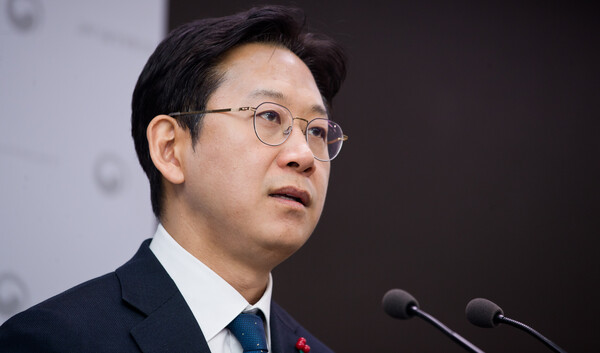
Baek Kyung-hoon (배경훈), South Korea's deputy prime minister and minister of science and ICT, discussed science and technology policy directions for the AI era with science and technology leaders from major countries in Kyoto, Japan. He also jointly announced the 'Kyoto Vision' with more than 10 countries including the United States.
The Ministry of Science and ICT said on Oct. 5 that Baek attended the 23rd Science and Technology in Society (STS) Forum held in Kyoto on Oct. 4.
The STS Forum is an international event where officials from governments, academia, research and industry around the world discuss the social role of science and technology and key issues. This year's event runs from Oct. 4 to Oct. 6 under the theme of "responding to tectonic shifts in science, technology and society."
During the STS Forum, Baek attended the 23rd Science and Technology Ministers' Meeting hosted by Japan's Cabinet Office and discussed the role of science and technology in social, geopolitical and technological environments with leaders from other countries. They exchanged views on directions for support for basic research, ways to speed up the social implementation of research outcomes, and directions for international cooperation in science and technology.
Baek stressed the need to shift science and technology policy to match the AI era. He also shared key policies being pursued by the ministry, including expanded support for basic research and innovation in the research and development support system. He introduced the "seven SEED projects" to foster advanced technologies as future growth engines, and the "K-Moonshot Project" to speed up solutions to major scientific challenges by using scientific AI.
Baek then attended the proclamation ceremony for the "Kyoto Vision," held under the leadership of the White House Office of Science and Technology Policy (OSTP). OSTP Director Michael Kratsios and representatives from more than 10 countries, including Japan, Britain and Germany, also took part.
The Kyoto Vision presents a direction for future science and technology policy in response to changes in the research environment, including the development of AI. Key elements include improving research support methods and systems, using AI in science, and fostering talent across the broader scientific ecosystem.
The ministry said it would use the joint announcement of the Kyoto Vision as a momentum to speed up scientific discovery and technological innovation. It also said it would actively take part in discussions on relevant international cooperation and continue institutional and policy innovation to accelerate technology-driven growth.
Baek said, "The domestic and external environments surrounding the R&D ecosystem are rapidly changing, including AI technological innovation and shifts in industrial paradigms." He added, "I will double our efforts to innovate science and technology policy to strengthen our R&D fundamentals and energise the research ecosystem."
Separately, Baek held a meeting with Kratsios to discuss the two countries' directions on science and technology and AI policy, including the Kyoto Vision. The two sides also exchanged views on ways to expand science and technology cooperation, including follow-up measures to the "South Korea-U.S. technology prosperity memorandum of understanding" signed on the occasion of a South Korea-U.S. summit in October 2025.
 Jin-ho Lee
jhlee26@d-today.co.kr
Jin-ho Lee
jhlee26@d-today.co.kr