
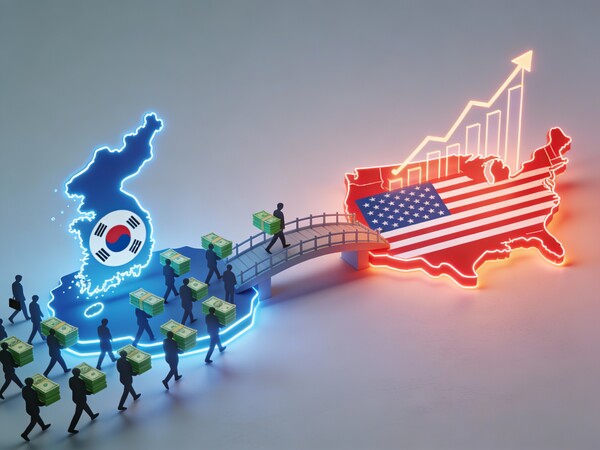
The KOSPI is setting fresh record highs day after day, but South Korean retail investors’ tilt toward U.S. stocks is not easing. Government efforts to defend the exchange rate are even being used by retail investors as an opportunity to buy dollars on the cheap, creating what looks like a “ping-pong game” that fuels renewed currency weakness.
Data from the Korea Securities Depository showed that through the 12th of this month, South Korean retail investors net bought a total of $2.37 billion of U.S. stocks, or about 3.49 trillion won.
It is the largest amount for the same period since comparable statistics began in 2011, based on the Jan. 1 to 9 window. Net buying early this year surged 74.5 percent from a year earlier, when it totalled $1.36 billion, or about 1.98 trillion won.
The most heavily net bought stock by Korean retail investors since the start of the year was Tesla, with purchases of $429.79 million, or about 633.8 billion won. It was followed by TSLL, a leveraged exchange-traded fund that tracks Tesla’s stock return at 1.5 times, at $341.49 million, or about 503.6 billion won, and Micron at $174.90 million, or about 257.9 billion won.
Alphabet, in fourth place at about 231.2 billion won, Palantir, in sixth at about 182.4 billion won, and Nvidia, in eighth at about 148.7 billion won, also ranked in the top 10 for net buying. That indicates aggressive, tech-heavy investment is continuing.
Experts see a “learning effect” behind the trend. They say when the government intervenes in the foreign-exchange market to push the exchange rate down artificially, investors view it as a chance to buy U.S. stocks more cheaply and move to buy dollars.
In fact, retail investors who had sold some U.S. stocks during a period of exchange-rate declines late last month shifted back to aggressive buying at the start of the year as the exchange rate lost momentum.
Moon Da-woon, an analyst at Korea Investment & Securities, said, “As overseas investment that had stalled due to exchange-rate burdens in the fourth quarter of last year increases again, dollar demand is rising and limiting the exchange rate’s decline.”
Financial authorities are scrambling to draw up countermeasures. They say the buying by Korean retail investors in overseas markets is acting as a factor of instability in the foreign-exchange market. To buy U.S. stocks, retail investors have to sell won and buy dollars. Authorities view the resulting large demand for dollar conversion as stoking rises in the won-dollar exchange rate, meaning a weaker won.
Lee Chan-jin, head of the Financial Supervisory Service, held a meeting on the day to review market conditions and pointed out that “despite the KOSPI’s recent rise, overseas stock investment and sales of foreign-currency financial products such as foreign-currency deposits and insurance are increasing due to vague expectations of rising overseas asset values.”
He added, “The bias is deepening due to vague expectations of rising overseas asset values,” and instructed officials to quickly prepare measures to induce Korean retail investors to return to the domestic market.
Authorities last year announced a “return to domestic market account” (RIA) that provides tax-exempt benefits to investors who sell overseas stocks and come back home, as part of steps to encourage a return to domestic equities. They plan to launch RIA next month and to continue recommending that financial firms refrain from excessive marketing of overseas stocks.
Market response has been lukewarm. Last year, the three major New York stock indexes rose 15 to 20 percent on the back of growth in the artificial intelligence industry and showed a solid trend, while distrust persists that the domestic market, with the 4,700 level in sight, “could fall again at any time.”
There also appears to be fear that after rising sharply, the market could plunge on a selloff with unknown downside pressure.
A financial investment industry official said, “Doesn’t this mean there is still a big gap between authorities’ policy and the actual market?” The person added, “Investors will gravitate on their own to attractive markets anyway, so it would be better to put more effort into revising the Commercial Act and shareholder return policies.”
 Oh Sang-yeop
yub@d-today.co.kr
Oh Sang-yeop
yub@d-today.co.kr