
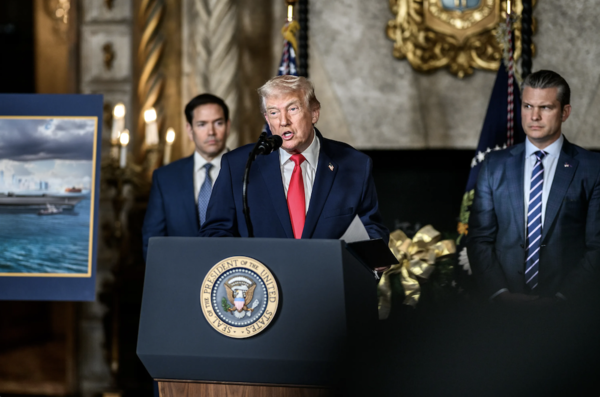
A final U.S. Supreme Court ruling is nearing on reciprocal tariffs imposed by the second Trump administration under the International Emergency Economic Powers Act (IEEPA). The court has announced it will release decisions in major cases on Jan. 14. The list is expected to include whether the Trump tariffs are legal. A ruling had also been expected on Jan. 9, but a decision on another matter was issued and the tariffs ruling was delayed.
In February last year, President Trump signed an executive order on a "Fair and Reciprocal Trade Plan" and imposed tariffs targeting countries with trade surpluses with the United States. In response, 12 states led by Democratic governors and small and midsize U.S. importers filed suit against the Trump administration.
In the second half of last year, a federal appeals court sided with the importers, saying IEEPA does not grant the president unlimited taxing authority. The administration immediately appealed.
The key issue is whether the president can exercise unlimited taxing power, which is an inherent power of Congress, on the grounds of a national security crisis. Trump, who has signed more than 35 tariff-related executive orders, has made clear he intends to maintain his tariff policy regardless of the ruling.
On Jan. 5, Trump wrote on social media, "We have collected or are going to collect $600 billion" through tariffs, and warned the United States would suffer a "severe blow" if it cannot impose tariffs. The Trump administration says that even if the Supreme Court rules against it, it can use other legal grounds, including Section 232 of the Trade Expansion Act, to levy tariffs by product category such as autos and steel.
If the Supreme Court rules the tariffs unconstitutional, administrative turmoil is expected as the administration would have to refund about $130 billion in tariffs already collected. In an interview with Reuters on Jan. 9, Treasury Secretary Scott Bessent said the Treasury's cash balance was nearly $774 billion as of Jan. 8 and that there was enough money for refunds. "The money does not go out all at once in a single day. It could take weeks, months, maybe more than a year," he said.
Alternative scenarios are also being discussed, including Section 232 of the trade law and the so-called Super 301 provision.
The ruling is also a major variable for the South Korean economy. South Korea's trade surplus with the United States last year was $49.5 billion, still its largest surplus with any country. The Trump administration classified South Korea as a top target for reciprocal tariffs and imposed a 15 percent tariff, hurting exports of key items such as automobiles, general machinery and auto parts. Exports to the United States last year fell 3.8 percent to $122.9 billion, but a double-digit increase in semiconductor exports reduced the overall decline.
If the Supreme Court rules for the administration, there is a risk that additional tariffs of 10 to 25 percent on South Korean cars will become entrenched. Pressure on exports of finished products is also expected to persist in the semiconductor sector despite expanded factory capacity in the United States.
Even if the administration loses, it may not be reassuring. A Heritage Foundation report says the Trump administration could pressure Congress to pursue stronger protectionist legislation. It said alternatives prepared as Plan B, including Section 122 and Section 232 of the trade law, Section 338 of the tariff law and the Super 301 provision that can be invoked by presidential executive order, are as strong as IEEPA.
In a worst-case scenario, there is also talk that former White House senior counsellor for trade and manufacturing Peter Navarro could return and revive the Smoot-Hawley Act. The Smoot-Hawley Tariff Act is a tariff law introduced during the Great Depression in 1930 to protect U.S. industry, imposing high tariffs on imports. Navarro previously pursued a hardline China policy during Trump's first term in office.
Yeoh Han-koo visits the United States, saying he will seek a strategy to minimise industry impact.
Debate is also expected over the appropriateness of South Korea's $350 billion investment pledge to the United States that it put forward during tariff talks. Lowering the threatened 25 percent reciprocal tariff rate to 15 percent was the counterpart to concessions to the United States, but if the tariffs are nullified, there could be criticism that the South Korean government made excessive concessions.
Against this backdrop, the South Korean government has been issuing daily messages suggesting there will be no major change in South Korea-U.S. trade relations even after the ruling. Kim Jeong-kwan, trade minister at the Ministry of Trade, Industry and Energy, expressed gratitude at a meeting with the American Chamber of Commerce in Korea on Jan. 9 over the fact that U.S. investment in South Korea last year rose 86.6 percent from a year earlier to a record $9.77 billion.
Kim said, "At a time when South Korean companies' investment in the United States is expanding after the conclusion of South Korea-U.S. tariff talks, increased investment in South Korea by U.S. companies is an achievement that shows bilateral investment cooperation is developing in a mutually beneficial way."
Yeoh, the minister for trade negotiations, is also visiting Washington, D.C. from Jan. 11 to 14 and meeting government, congressional and industry figures including at the Office of the U.S. Trade Representative. With the Supreme Court set to rule on whether reciprocal tariffs based on IEEPA are illegal, Yeoh plans to listen broadly to developments in the United States to seek response strategies to minimise the impact on industry.
The government says it is preparing on the view that, whichever way the Supreme Court rules, South Korea will face trade pressure demanding it reduce its trade surplus with the United States.
 Suk Daegeon
d2dg@d-today.co.kr
Suk Daegeon
d2dg@d-today.co.kr