
An amendment to the game industry law strengthening overseas game companies' responsibility to protect users in South Korea has passed parliament. The core of the change is to raise the effectiveness of the system by specifying criteria for appointing a domestic agent and duties for management and oversight, and by writing into law game-related business operators' duties to protect users from harm and handle complaints.
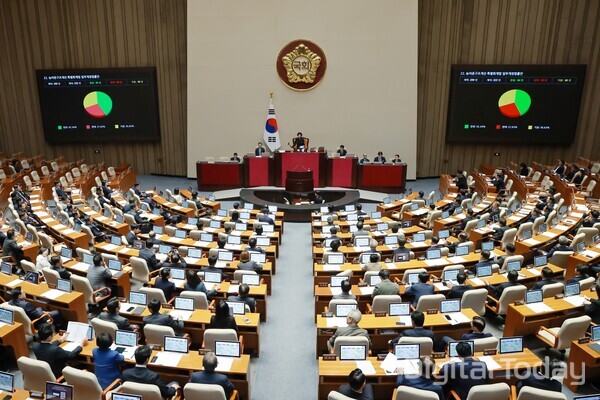
The National Assembly on Oct. 1 passed at a plenary session the partial amendment bill to the Game Industry Promotion Act. The Culture, Sports and Tourism Committee merged bills separately proposed by Cho Seung-rae (조승래), a lawmaker of the Democratic Party, and Kim Jae-won (김재원), a lawmaker of the Rebuilding Korea Party, and prepared them as an alternative.
The revision is intended to address criticism that while the domestic agent system for overseas game firms is in force, some operators do not appoint an agent or run it only in form. That has been cited as limiting user protection and law enforcement.
Previously, a person with an address or place of business in South Korea could be appointed as a domestic agent. Under the amendment, if an overseas game firm has a South Korea-incorporated entity it established, or a South Korea-incorporated entity over which it exerts dominant influence in areas such as executive composition and business operations, that entity must be appointed first. If no such entity exists, another corporation that can faithfully carry out domestic agent duties may be appointed.
Oversight responsibilities for overseas game firms are also strengthened. Operators must manage and supervise domestic agents by providing training and checking work status so the agent can faithfully perform relevant duties. They must also keep the domestic agent appointment in place while providing game services in South Korea.
If a company does not appoint a domestic agent, appoints one in a manner different from what the law prescribes, or fails to carry out duties to train, manage and supervise the agent, it will be subject to an administrative fine of up to 20 million won. A basis was also 마련됐다 for the culture minister to issue corrective orders for violations of the domestic agent system.
User protection duties have also been newly written into law. The amendment adds to the compliance items for game-related business operators a requirement to respond to protection from harm and complaint handling for users in South Korea, and includes this within the scope of a domestic agent's work.
The provision applies to "game-related business operators" and is not limited, in the text of the law, to overseas operators that appoint a domestic agent. As a result, South Korean game companies will also take on an additional legal duty, beyond existing compliance items, to respond to user harm and complaints.
The government's and the Game Rating and Administration Committee's authority to secure materials has also been strengthened. If there is suspected legal violation, or a related report or civil complaint has been received, or if it is necessary to confirm whether a company is subject to domestic agent designation, the culture minister or the committee may require an operator to submit relevant materials.
If an operator, without justifiable grounds, fails to submit materials or submits false materials, it will be fined up to 10 million won. The duty to submit materials is also not limited to overseas operators, so South Korean game companies will also be subject to it.
Sanctions tools for violations such as breaches of obligations to disclose information on probability-based items have also been strengthened. If a corrective order is issued for a related violation and it is not complied with, a basis has been 마련됐다 to order information and communications service providers and others to refuse, suspend or restrict handling of the relevant game product.
The amended game industry law will take effect six months after it is promulgated following a Cabinet meeting. Among operators that have already appointed a domestic agent, those with a South Korea-incorporated entity that meets the amended priority appointment requirements must reappoint a domestic agent from among those entities within six months after the law takes effect.
Under the current enforcement decree of the game industry law, overseas game companies that distribute or provide games with total sales of at least 1 trillion won in the previous year, or with an average of at least 1,000 installations per day on mobile telecommunications terminals in South Korea, must appoint a domestic agent.
 Ho-jung Lee
lhj@d-today.co.kr
Ho-jung Lee
lhj@d-today.co.kr