
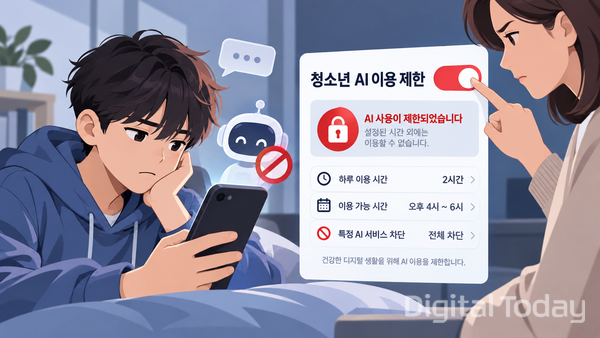
A bill will be introduced to require a so-called "AI shutdown" feature that can limit minors' usage time on generative AI services. It would require providers to offer functions that restrict AI usage time or time slots if requested by a minor or a parent.
Ahn Oct. 1 statement from the office of Lee Ju-hee (이주희), a Democratic Party lawmaker on the National Assembly's Science, ICT, Broadcasting and Communications Committee, said Lee plans to introduce as soon as this week an amendment to the Act on Promotion of Information and Communications Network Utilization and Information Protection.
The revision would impose a duty on operators of interactive information and communications services based on generative AI to take protective measures to prevent excessive use by minors under 19.
Providers would first have to verify a user's age and whether the user is the person in question. They would also be required to display cautions on excessive use and logs showing elapsed usage time.
In particular, if requested by a minor or a legal representative, providers would have to offer means to restrict how the service is used, usage time and time slots.
Unlike the previous game shutdown system that uniformly blocked minors' access during certain hours, the proposal would allow limits to be set at the request of a user or legal representative. Detailed methods and procedures for protective measures, and ways to verify minors and legal representatives, would be set by presidential decree.
Companies that fail to carry out the measures would face fines of up to 30 million won. If the bill passes the National Assembly, it would take effect 6 months after promulgation.
The scope would cover interactive information and communications services based on generative AI under the Framework Act on Artificial Intelligence Development and Building a Foundation of Trust. General-purpose AI chatbots such as ChatGPT, Gemini and Claude could be covered, and generative AI-based character chat services such as Zeta and Crack could also potentially be included.
The current law stipulates that when providing interactive information and communications services to children under 14, providers should strive to ensure they are not supplied with inappropriate information. The amendment differs in that it expands protection to minors under 19 and imposes specific duties to prevent excessive use of generative AI.
As teenagers' use of generative AI spreads rapidly, calls to strengthen related safeguards have continued. A March survey by ChildFund Korea of 3,300 children and adolescents aged 14 and older nationwide found 94.4 percent said they had used generative AI chatbots. Among those who said they had asked chatbots about risky, illegal, violent or sexual content, more than half were found to have actually received related answers.
AI companies are also moving to strengthen youth protection features. OpenAI operates a separate protection system for teenage users and offers functions allowing parents or guardians to link to teen accounts and restrict ChatGPT use during certain hours.
In the bill's explanation of its purpose, Lee said, "With the spread of generative AI-based interactive services, issues have been raised about minors' long hours of use, late-night use or excessive immersion. The aim is to provide means for minors to manage usage time on their own and create a sound environment for using information and communications services."
 Seul-gi Son
sageson@d-today.co.kr
Seul-gi Son
sageson@d-today.co.kr