
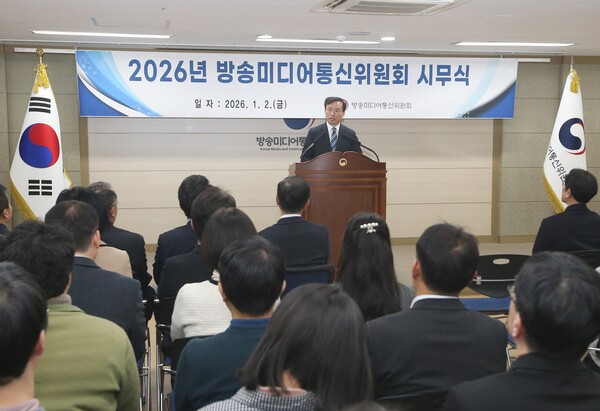
The Broadcast Media Communications Commission has remained effectively idle more than 100 days after its launch. Delays in appointing members nominated by parliament have prevented it from playing the control tower role for broadcast and media policy as expected. Normalisation is seen as possible as early as late this month.
The commission officially launched on Oct. 1 last year. It was intended as an integrated regulatory and coordinating body covering broadcasting, telecommunications and platforms to respond to a rapidly changing media environment. But since its launch it has not held a single plenary meeting for policy decision-making. It has raised anchor with its launch but has yet to row even once.
The commission has not been able to operate normally because nominations for members allocated to parliament have been delayed. Under the law establishing the commission, it consists of 3 standing commissioners including the chair and 4 non-standing commissioners. The president and the ruling and opposition parties each nominate 1 standing commissioner. For non-standing commissioners, the president and the ruling party each nominate 1 and the opposition nominates 2.
A plenary meeting can open if at least 4 of the 7 registered members attend. An agenda item can be approved if a majority of those present vote in favour. The commission currently has 2 members: Chair Kim Jong-cheol and non-standing commissioner Ryu Shin-hwan, both nominated and appointed by the president. If the Democratic Party completes nominations for 2 members allocated to the ruling party, one standing and one non-standing, the structure would allow decisions along with Kim and Ryu.
But the Democratic Party’s recruitment process for commissioners is dragging. It began recruitment in December last year and held candidate interviews, but the final decision has been delayed after it moved to additional recruitment immediately after the interviews. Nominations by the opposition People Power Party are also delayed. It closed candidate applications last month but has not yet set an interview schedule, it was reported.
The Democratic Party says it will speed up nominations now that its floor leader election ended on Jan. 11. But because recruitment began late, a concrete outline is expected to emerge as early as late this month.
The commission also hopes parliament will swiftly nominate members. Kim met National Assembly Speaker Woo Won-shik on Jan. 8 and stressed the urgency of forming the panel. "As a consensus-based body, there is nothing I can do alone," Kim said. "Only if you promptly form the commission together with the National Assembly negotiating groups can we resolve the piled-up pending issues," he said.
The delay in forming the panel has led to a policy vacuum. As soon as the commission’s membership is completed, it must handle major pending issues including follow-up enforcement decrees for amendments to three broadcasting laws, renewal reviews for terrestrial broadcasters and normalisation of public broadcasters. It must also address revisions to the enforcement decree of the Telecommunications Business Act after the repeal of the Mobile Device Distribution Act and the imposition of fines for overseas big tech firms’ forced in-app payment violations.
Revisions to subordinate regulations under the "Act to eradicate false and manipulated information," approved at a Cabinet meeting last month, are also the commission’s responsibility, but related discussions have not reached the starting line. Since taking office, Kim has repeatedly stressed the need for a strong response to false and manipulated information. But delays in forming the commission have kept related policy from moving to the execution stage.
The industry has also suggested moving away from appointments centred on legal experts. Kim is a professor at Yonsei University Law School, and Ryu is a former lawyer. A source familiar with the commission said both parties should complete nominations as soon as possible without political calculation, and that commissioners strong on pending issues should be appointed with a focus on careers related to broadcast media.
 Jin-ho Lee
jhlee26@d-today.co.kr
Jin-ho Lee
jhlee26@d-today.co.kr