
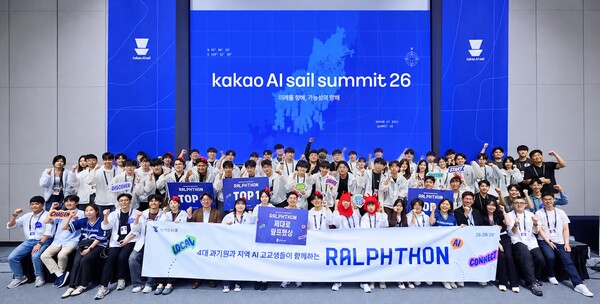
Kakao unveiled business plans in Busan to share artificial intelligence transformation (AX) cases by affiliate and to support local AI talent and entrepreneurs.
Kakao's AI talent and business development body, Kakao AI Sail, said on Oct. 1 it held the 'Kakao AI Sail Summit 26' on Sept. 29 at the Busan Port International Exhibition and Convention Center. About 800 people, including local AI talent, entrepreneurs and developers, took part.
Group affiliates including Kakao, Kakao Mobility, KakaoBank, Kakao Pay and Kakao Pay Insurance took part and introduced AI technologies and AX cases applied in their respective business areas.
Kakao shared how developers' roles are changing with the introduction of AI and cases of building an AI-based coding environment. Kakao Mobility presented the direction of future mobility services using autonomous driving technology, while KakaoBank 발표했다 measures to build financial AI datasets and secure the stability of AI systems.
Kakao Pay introduced cases of applying AI-based financial search and coaching, while Kakao Pay Insurance introduced a case of redesigning insurance screening using AI.
Kakao AI Sail also unveiled a business structure to support local AI talent and companies. It is designed in three stages: AI talent development, startups and commercialisation, and connecting and expanding the regional ecosystem, with support planned from education through startups and investment links.
In the talent development stage, it plans to boost AI capabilities among local teenagers and university students through programmes such as the Kakao AI Rookie Camp, Tech for Impact Campus and Kakao Tech Campus, then link them to startup programmes.
In the startup and commercialisation stage, it will provide development infrastructure including graphics processing units, AI models and storage space through an 'AI Growth Platform' to students at four science and technology institutes and local prospective founders. It will also run 'Ralphthon', which turns ideas into minimum viable products in a short period, and 'Departure', which links AI startup teams to investment review and business cooperation.
In the regional ecosystem stage, it plans to expand exchanges among entrepreneurs, investors and industry experts through networking events and a Busan AI hub targeted to be established within the year. It also plans to support solving AX challenges in local industries by using deep-tech capabilities at science and technology institutes and Kakao's AI technology.
About 60 people, including students from the four science and technology institutes and high school students in the Busan, Ulsan and South Gyeongsang regions, took part in the Ralphthon held that day. Participants used AI agents to move from finding ideas to building products and giving presentations.
External AI companies also joined the event. Park Sung-hyun (박성현), CEO of Rebellions, introduced infrastructure conditions and potential based on AI semiconductor technology. Kim Sung-min (김성민), an applied AI engineer at OpenAI, shared ways to develop and verify software using the coding agent 'Codex'.
Kim Young-deok (김영덕), head of Kakao AI Sail, said, "We will create a virtuous cycle structure in which problem-solving experience leads to startups by connecting local talent, companies and experts, and grown companies again create local innovation."
 Ho-jung Lee
lhj@d-today.co.kr
Ho-jung Lee
lhj@d-today.co.kr