
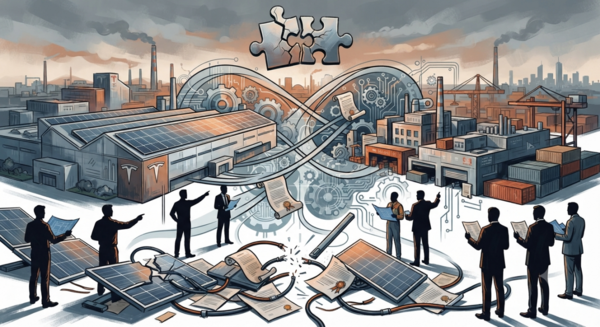
Tesla's plan for a large solar factory it is pursuing in Texas has faced an uncertainty factor in the form of a patent lawsuit over key production equipment. A legal dispute between Chinese solar equipment makers could affect Tesla's schedule for building its production lines.
Electrek, an electric vehicle media outlet, reported on Sept. 30 local time that Linton Crystal Technologies, an affiliate of China's Dalian Linton, filed a patent infringement lawsuit against Zhejiang Jingsheng Mechanical & Electrical in the U.S. District Court for the Eastern District of Texas.
At the centre of the lawsuit is technology for CZ-method crystal growth furnaces used to produce monocrystalline silicon ingots. Linton claims Jingsheng infringed two of its U.S. patents. The patents relate to a structure that lifts and rotates silicon seeds, and the first patent is known to expire in 2040.
Linton is seeking damages, up to triple damages for willful infringement, and a permanent injunction barring sales and use. Industry attention is focused on the risk that any injunction could affect the supply of equipment needed for solar production lines.
Ingot production is the starting point for making solar wafers. After growing silicon into crystalline ingots, they are cut into wafers and then processed into cells and modules. As a result, disruptions in the supply of crystal growth equipment could also affect the build-out of downstream production lines.
Jingsheng took a different position on the lawsuit. The company said on Sept. 24, in a disclosure to investors, that its products use a "completely different technical solution" from the patents. It also said it has not yet been served with the formal complaint and expects the lawsuit will not have a material impact on its business.
Tesla is not a direct party to the lawsuit. Neither Tesla nor Jingsheng has officially confirmed an equipment supply contract between the two.
Still, China's local industry has reported that Tesla held tenders early this year for 210 mm monocrystalline ingot pullers, wafer cutting equipment and quartz crucibles. The report said equipment shipments began in April after a contract was signed in March, with deliveries discussed through the third quarter. It also said Jingsheng won the order for ingot pullers.
These equipment procurement plans align with the large solar manufacturing facility Tesla is pursuing. Tesla applied in August for a factory construction plan worth a total of $10.1 billion in Fort Bend County, Texas, called "Project Crystal Sun".
The factory is aimed at a vertically integrated production facility that performs everything in one place, from silicon ingot growth to wafer and cell production and final solar module manufacturing. Tesla has presented a plan to start production in early 2029.
In March, there was also a report that Tesla was discussing a plan to bring in about $2.9 billion worth of China-made solar production equipment on the condition of delivery before this fall. It suggested a structure in which Tesla expands its solar manufacturing base in the United States while relying on China's supply chain for a significant portion of production facilities.
For equipment makers, Tesla-related orders are also an important business opportunity. Jingsheng's revenue in the first half of 2026 was reported to have fallen by about 40 percent from a year earlier, and Dalian Linton also posted a slight loss over the same period. With orders for production facilities falling amid oversupply in China's solar manufacturing industry, winning large U.S. projects has taken on greater significance.
Linton has stressed that its engineers have developed crystal growth technology over decades in Rochester, New York. Jingsheng, meanwhile, has maintained its claim that its equipment uses a different technical solution from Linton's patents.
The dispute also shows that Tesla depends on China-made production equipment and supply chains as it expands solar manufacturing capabilities in the United States. Tesla has previously presented a goal of expanding solar manufacturing capacity in the United States to 100 GW by the end of 2028.
For now, it is difficult to conclude that the patent lawsuit will directly halt Tesla's equipment supply or plant operations. Tesla has not officially confirmed whether it actually sources the equipment from Jingsheng, and Jingsheng also denies patent infringement. The court's ruling, whether an injunction is issued, and the actual execution of equipment supply contracts remain key variables that could affect the Project Crystal Sun schedule.
 Jinju Hong
hongjj@d-today.co.kr
Jinju Hong
hongjj@d-today.co.kr