
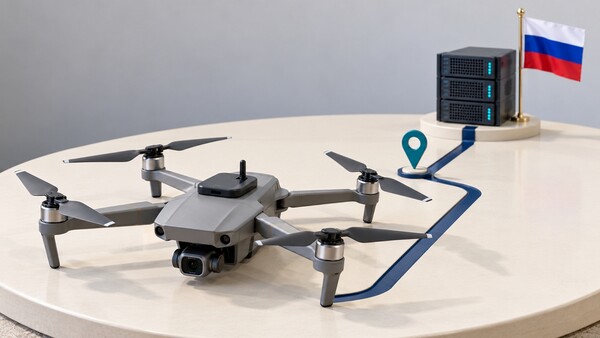
Russia is tightening control by linking civilian drones' connection to a national tracking system with flight plan approval.
Tech outlet TechRadar reported on Sept. 30 local time that from Oct. 1 Russia will reject flight plan submissions for civilian drones weighing more than 250 grams unless connection to the national telematics platform ERA-GLONASS is confirmed. Drone owners must have the active status of their ERA-GLONASS account verified when submitting a plan to the state air traffic management corporation.
The measure is less about creating a new tracking regime than about tying the remote identification system launched in March to actual flight permit procedures. A government decree in February required civilian drones weighing more than 250 grams to transmit identification numbers, aircraft type, location coordinates and altitude to ERA-GLONASS from March 1.
ERA-GLONASS was originally built as a national system to handle emergency rescue requests in the event of car accidents. Its role later expanded into an integrated identification platform for civilian unmanned aircraft. It can receive information from multiple devices, including mobile communications and satellite and hybrid trackers and ADS-B, and deliver it to supervisory agencies and air traffic authorities.
There is a significant gap between the system's stated processing capacity and current uptake. Aleksei Raikevich (알렉세이 라이케비치), chief executive of JSC GLONASS, said in January it can monitor up to 1,000,000 civilian unmanned vehicles on land, water and in the air in real time. By contrast, as of September there were 1,027 actual connection users and only 1,205 registered drones.
It is still unclear whether it can forcibly stop or land drones. Russian officials have referred to functions to halt drone movement in emergencies or to force aircraft in specific areas to land all at once. But the government decree made public so far mainly sets out a structure in which drones send location and identification information to the national system, and it does not clearly stipulate a control link for ERA-GLONASS to send stop-flight commands directly to aircraft. JSC GLONASS also described a so-called "red button" in June as a function to be introduced in the future.
Russia aims to use a centralised identification system to track the location of civilian drones and their operators in real time and, in the long term, ease flight restrictions by region. It remains to be seen what impact tighter tracking obligations will have between expanding the civilian drone industry and state control.
 Jae-won Choi
ittt_0801@d-today.co.kr
Jae-won Choi
ittt_0801@d-today.co.kr