
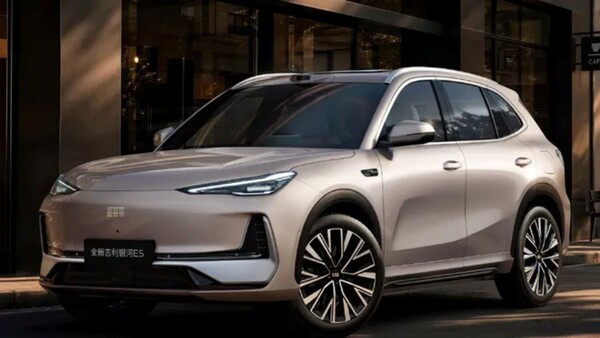
[DigitalToday reporter Jinju Hong (홍진주)] Chinese EV maker Geely deployed 2.2-megawatt ultra-fast chargers in five Chinese cities within a week of unveiling them. China's EV industry is rapidly shifting from a power race over megawatt-class charging infrastructure to a competition over commercialization and rollout speed.
Electrek reported on Sept. 30 that Geely is operating 2.2-MW chargers in five cities including Hangzhou, Shanghai, Ningbo, Jiaxing and Xi'an. Geely plans to build 15,000 charging hubs by the end of next year.
Geely highlighted as a key performance point that the charger can charge a vehicle in under 5 minutes. The 2.2-MW output is not delivered through a single charging head. The system operates at 1,500 volts and 1,500 amps, with two charging heads splitting the power.
Because a single vehicle cannot currently take in the full 2.2 MW, actual operation is closer to two vehicles each receiving more than 1 MW. Even so, it is seen as meaningful that megawatt-class output has been applied in a real commercial environment for passenger EV charging infrastructure.
Geely is emphasizing rapid rollout rather than maximum output itself. After unveiling a 1.5-MW charger in March, it raised output to 2.2 MW in about 6 months. It said it also applied an "advanced thermal management algorithm" to reduce battery life degradation from high-output charging.
Megawatt-class charging infrastructure is spreading quickly in China. Local EV makers have installed large numbers of chargers aimed at charging within 5 to 10 minutes and are competing to cut charging time in increments of seconds.
BYD is also showing rapid rollout. After unveiling a 1.5-MW charging system in March, BYD installed 10,000 chargers in just 5 months. Geely also plans to pursue infrastructure expansion on a similar scale.
Alongside expanding charging infrastructure, Geely is also broadening its battery swapping business. The company announced it bought part of the battery swapping business unit of Chinese battery swapping service provider Nio.
In contrast, the pace of commercialization of ultra-fast charging infrastructure is relatively slow in the United States. While 350 to 400 kilowatt chargers are still not widely deployed at U.S. charging stations, EVgo plans to introduce a 750-kW charging system next year. The timetable, initially expected in the second half of 2026, has been pushed back to 2027.
EVgo's 750-kW system also shares power across multiple charging bays. The actual output delivered to an individual vehicle can vary depending on charging conditions and vehicle performance. Passenger EVs that can handle that level of output are also limited in the U.S. market.
Tesla is also taking time to expand megawatt-class charging infrastructure in the United States. Tesla unveiled the V4 Supercharger in 2022 with support for up to 500 kW, but it took about 3 years for installations to materialize. Many Superchargers in the United States are still at 350 kW or less.
The Megacharger for the Tesla Semi supports up to 1.2 MW, but it serves a different purpose from charging infrastructure for passenger EVs. Elon Musk (일론 머스크), Tesla's CEO, has in the past referred to chargers of 350 kW or less as "kids' toys."
U.S. policy on expanding charging infrastructure is also a variable. The Inflation Reduction Act and the Infrastructure Investment and Jobs Act include provisions to support expansion of EV chargers, but there is criticism that the actual buildout pace has fallen short of initial expectations due to various procedures and policy variables at the federal and state levels.
On top of that, U.S. tariffs and a regulatory stance on Chinese-made EVs are overlapping, sustaining an environment in which U.S. consumers have difficulty directly accessing EV and charging technologies that are advancing rapidly in China.
Ultimately, the benchmark in the EV charging race is shifting from simply "what is the maximum output" to "how quickly it can actually be installed and operated." As Chinese companies rapidly deploy megawatt-class chargers in urban areas and major hubs, delays in next-generation high-output charging plans in the United States are further highlighting the gap in infrastructure buildout speed between the two countries.
 Jinju Hong
hongjj@d-today.co.kr
Jinju Hong
hongjj@d-today.co.kr