
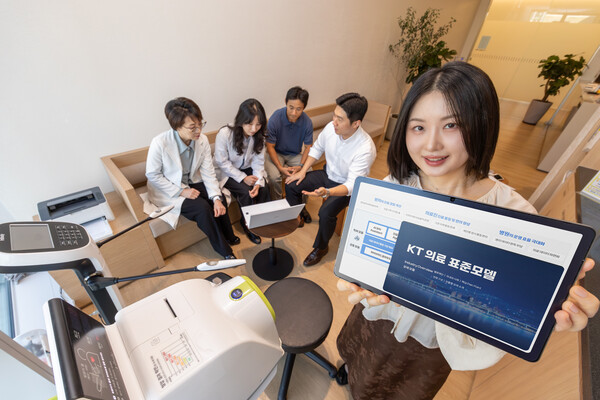
KT is targeting the hospital AI transformation (AX) market with a "medical standard model" that bundles infrastructure, a data platform and AI services tailored to each hospital's needs.
KT said on Wednesday it will expand adoption of the medical standard model at advanced general hospitals and general hospitals nationwide.
KT identified key AX application areas across hospital operations through customer analysis of medical staff and hospital management. The areas include patient guidance, clinical administration, workforce and facility operations, and medical data use. Based on this, it set out the medical standard model to support improvements in patients' care experience, boost efficiency for medical staff and improve hospital operating efficiency.
For patient-facing services, it will apply an "AI patient assistant". It uses an AI voice bot to automatically respond to inquiries around the clock and classify symptoms to support appointment bookings. It also provides guidance for post-discharge patient management. In the first quarter of next year, it will add a retrieval-augmented generation (RAG) function based on medical knowledge.
KT will also provide a nurse scheduling agent and an operating room scheduling agent. Its medical data platform collects and stores electronic medical records, medical imaging, and test and research data, and links data based on standards for exchanging medical information. The company plans to provide not only medical data search within hospitals, but also data building for AI training and an environment for developing and verifying medical AI.
KT will also use a clinical administration agent to reduce administrative work for medical staff. It recognises and analyses conversations between medical staff and patients to write clinical notes reflecting medical terminology and abbreviations, applying templates and formats by department. After confirmation and approval by medical staff, it links with electronic medical records and test and prescription systems to automate work from drafting clinical records to orders and billing.
KT plans to expand the standard model into areas that support diagnosis and reading and clinical decision-making by combining solutions from specialised medical companies with its medical data platform and infrastructure such as hybrid cloud. It said implementation is possible for an AI cancer diagnosis clinical decision support system (CDSS) that presents clinical guidelines and treatment evidence based on integrated patient clinical and imaging information, and AI endoscopy reading that analyses endoscopy images in real time.
KT will also participate in the government's "AI basic medical strategy", including tasks for AI-specialised hospitals, based on the medical standard model. It will verify services by hospital environment and expand the scope of application. KT will also reorganise its medical AX specialist organisation. This month, it will hold a medical AX seminar by inviting officials from general hospitals to discuss ways to improve medical productivity and innovate hospital management.
Bong-kyun Kim (김봉균), executive vice president and head of KT's enterprise division, said each hospital has different systems and data environments and different priorities for driving AX. He said KT will combine its infrastructure and AX capabilities to provide a foundation for hospitals to introduce needed services and expand them in stages.
 Jin-ho Lee
jhlee26@d-today.co.kr
Jin-ho Lee
jhlee26@d-today.co.kr