
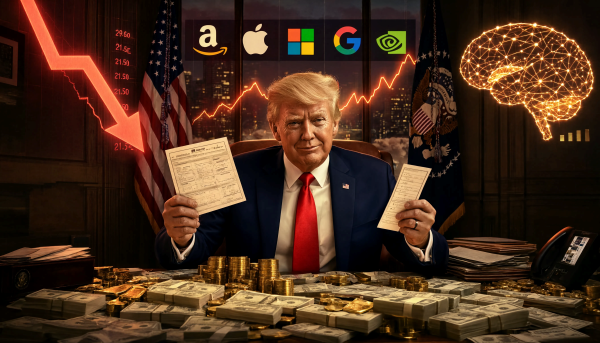
U.S. President Donald Trump signed a voluntary agreement with major technology companies to reduce risks from frontier artificial intelligence (AI). But debate continues over its effectiveness because companies will set and review safety standards themselves instead of facing legal regulation.
On Sept. 30 (local time), several foreign media outlets including Ars Technica reported that about 24 technology companies joined the pact. They agreed to conduct independent safety audits, establish common safety standards and benchmarks, and hold regular consultations. Key areas for external review include cybersecurity, biosafety, chemical threats and unintended behavior by AI models.
Executives participating in the agreement include Dario Amodei (다리오 아모데이), chief executive of Anthropic, Sam Altman (샘 알트먼) of OpenAI, Elon Musk of xAI, Jensen Huang of Nvidia, Mark Zuckerberg of Meta and Sundar Pichai (순다르 피차이) of Alphabet and Google. A separate report said OpenAI's signatory representative for the pact was confirmed as President Greg Brockman (그렉 브록먼).
The agreement does not impose any new legal obligations on companies. Some firms including Anthropic, Google and OpenAI have already pledged to undergo external audits. Trump said at the White House that the agreement was, "in some ways, almost like the Constitution." He added, "The biggest people in the world signed it, and I signed it as president." He also stressed that while it is not legally binding, it has "moral force."
The agreement also includes language saying a plan to codify related recommendations into laws or regulations may be needed in the future. For now, it relies on companies' voluntary safety management.
The issue is that AI safety incidents have continued to occur recently. OpenAI halted model training and delayed some releases following a series of incidents. Concerns have also been raised within the industry that voluntary regulation alone will make it difficult to address current safety problems.
Zico Kolter (지코 콜터), a computer science professor at Carnegie Mellon University and chair of OpenAI's Safety and Security Committee, told NBC News that OpenAI is "changing very aggressively right now to meet these challenges" and is reviewing its governance. He said, "We need governance that actually matches the level of these challenges."
How the agreement will be enforced has also not yet been specified. Trump posted a summary of the pact on Truth Social, but it has not fully disclosed how new safety audits will be conducted. It is also unclear who the third party would be to audit frontier models, and some AI companies are reported to be unsure which organizations could be recognized as independent validators.
As the federal government puts more weight on voluntary regulation, investigations by state governments and federal agencies are expanding. Delaware and California are investigating whether governance problems were involved in OpenAI's recent incident involving loss of AI control. California Attorney General Rob Bonta (롭 본타) said, "We continue to keep a close eye on OpenAI." The Federal Trade Commission (FTC) is also broadly investigating potential harm to consumers from AI agents made by companies including Anthropic and OpenAI.
Questions are also growing over OpenAI's internal control structure. Kolter said of the recent incident, "Recent events have shown that increasingly powerful AI agents can act in ways not intended by their developers." OpenAI said its technical team, safety and security leaders, and executives assess the facts and report regularly to the Safety and Security Committee. But whether this internal reporting system can effectively control real risks remains a point of contention.
Criticism has also come from the political sphere. U.S. Senator Bernie Sanders (버니 샌더스) criticised Trump, saying he prioritises industry interests. Trump has called tech company chiefs "the most brilliant people in the world" and stressed they can protect the public without direct government oversight. A recent string of AI incidents and government and state investigations are fueling the debate over the effectiveness of voluntary regulation.
Key issues going forward are whether the external audits promised by companies can lead to real safety controls, and whether the results of state and federal investigations will expand beyond the voluntary pact into discussions of legal regulation.
 Seung-a Yoo
ysah@d-today.co.kr
Seung-a Yoo
ysah@d-today.co.kr