
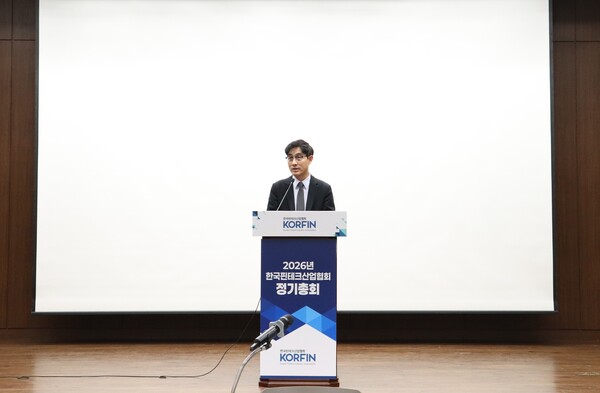
Kim Jong-hyun (김종현), CEO of Kookon, was elected as the sixth chairman of the Korea Fintech Industry Association, drawing the fintech industry's attention to the tasks the new leadership must resolve. The industry's scale has grown, but unclear regulatory direction and application standards are limiting the pace of business expansion.
The financial industry on Feb. 27 said the fintech industry is facing broad institutional changes at the same time. They include raising limits on prepaid balances, introducing a MyPayments business, strengthening payment risk management for electronic financial business operators and evaluating the financial soundness of lower-tier payment gateway firms. Tighter standards on information security, anti-money laundering and internal controls are also raising supervisory expectations.
The issue is not the need for regulation itself, but how it is applied. An analysis says burdens are increasing for small and mid-sized fintech firms with limited capital and staffing as uniform, ex-ante regulation expands without fully reflecting different risk levels by sector and business model.
Under such a structure, companies must build security infrastructure and internal control systems separately, sharply increasing fixed costs. This creates a structural burden in which resources that should go to innovation investment shift to regulatory response costs. The industry sees this not as a simple regulatory issue but as a matter of industrial competitiveness. A system environment with low predictability increases uncertainty in raising investment and pushing new businesses.
In particular, in new business areas such as payments, MyData, digital assets and small overseas remittances, business structures can change depending on how rules are interpreted, making regulatory risk management a key management variable.
Some in the industry also argue separate legislation is needed to comprehensively govern the fintech industry. They say major laws such as the Electronic Financial Transactions Act and the Banking Act were designed on the premise of a traditional financial system and do not sufficiently reflect platform- and data-based business models.
Legal entity push and building shared infrastructure
Against this backdrop, solutions presented by the new chairman can be summarised in three strands. First, he outlined a plan to establish a standing consultation structure with the National Assembly and financial authorities by turning the association into a statutory body.
He also plans to build shared infrastructure reflecting supervisory standards for member firms to use jointly. He said the regulatory goals of consumer protection and financial stability would be maintained, while setting a negative regulatory environment as a policy agenda under which rules are applied differently depending on risk levels.
The shared infrastructure plan is seen as an approach to make compliance costs previously borne by individual firms "shared and standardised". The calculation is that if association-level standard guidelines and infrastructure are institutionally recognised, firms could reduce overlapping investment and focus resources on service development.
Feasibility remains a variable, however. Converting the association into a statutory body would require legislation, and some point out it will be difficult to accelerate a shift in the regulatory framework without a change in supervisory stance. How far industry demands will be reflected amid a push to strengthen consumer protection will also be a key issue.
In the end, an assessment says the success or failure of Kim's leadership depends not on whether regulation is eased but on whether it can be redesigned into a more predictable and rational structure. Attention is focused on whether policy negotiating power can ease the cost structure of regulatory responses.
Kim stressed action-oriented operations as the association's core vision. "I will move forward as a performance-oriented association that connects the industry's demands to institutional improvements and policy changes," he said.
"The fintech industry is core infrastructure that supports people's daily lives and the financial ecosystem," he added. "Together with member firms, I will bring together a single voice for the industry and create changes that can be felt on the ground."
 Ji-young Lee
ljy@d-today.co.kr
Ji-young Lee
ljy@d-today.co.kr