
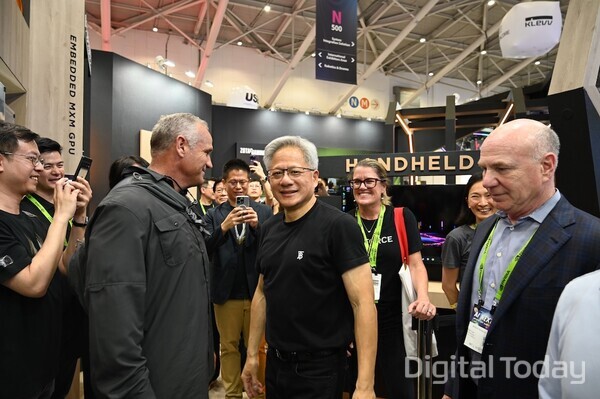
It was confirmed that last year the global semiconductor market was dominated by Nvidia. Nvidia became the first company in the semiconductor industry to surpass $100 billion in annual revenue.
Gartner said on Jan. 13 that global semiconductor revenue in 2025 rose 21 percent from a year earlier to $793 billion. Core AI components accounted for about a third of total revenue and drove market growth. Nvidia stayed in first place, rising 63.9 percent to $125.7 billion in revenue. Samsung Electronics held on to second place, rising 10.4 percent to $72.5 billion.
Nvidia alone drove more than 35 percent of global semiconductor market growth in 2025. Samsung Electronics' memory revenue rose 13 percent from a year earlier, but its non-memory revenue fell 8 percent.
HBM accounted for 23 percent of the DRAM market and revenue surpassed $30 billion. AI processor revenue exceeded $200 billion. Gartner forecast that AI semiconductors will account for more than 50 percent of total semiconductor revenue by 2029.
SK Hynix grew 37.2 percent to $60.6 billion on expanding HBM demand, rising to third place and overtaking Intel. Intel fell to fourth as revenue slipped 3.9 percent to $47.9 billion. Intel's market share fell to 6 percent, down to about half of its 2021 level. Micron Technology grew 50.2 percent to $41.5 billion, taking fifth place.
Qualcomm grew 12.3 percent to $37 billion, ranking sixth. Broadcom held seventh with $34.3 billion, up 23.3 percent. AMD rose 34.6 percent to $32.5 billion, ranking eighth. Apple and MediaTek ranked ninth and 10th with $24.6 billion and $18.5 billion, respectively. The rankings changed for 5 of the top 10 semiconductor suppliers.
Rajiv Rajput, a senior principal analyst at Gartner, said, "Core AI components such as processors, high-bandwidth memory (HBM) and networking parts led unprecedented growth in the semiconductor market, accounting for about a third of total revenue in 2025." He said, "With AI infrastructure spending forecast to exceed $1.3 trillion in 2026, the influence of AI semiconductors will grow further."
 Daegeon Seok
d2dg@d-today.co.kr
Daegeon Seok
d2dg@d-today.co.kr