
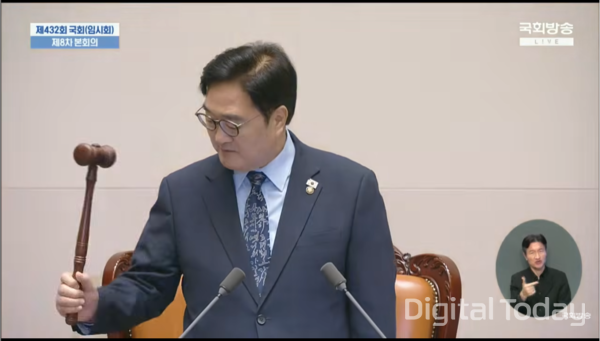
South Korea’s National Assembly again failed to secure a decision-making quorum for the Broadcasting Media Communications Commission. At a plenary session on Feb. 26, it approved a nomination of Ko Min-soo, a professor at Gangneung-Wonju National University, recommended by the Democratic Party. It rejected the nomination of Cheon Young-sik, head of Pen & Mic, recommended by the People Power Party. Even if Ko is appointed, the commission would still have three members, short of the four needed for decisions, and follow-up rules under the three broadcasting laws are expected to face setbacks.
The National Assembly held a plenary session and handled two nominations for standing commissioners through an electronic secret ballot. Ko’s nomination was approved with 228 votes in favour, 17 against and 4 abstentions. Cheon’s nomination was rejected with 116 in favour, 124 against and 9 abstentions. A National Assembly recommendation passes with the support of a majority of lawmakers present, and Cheon’s nomination fell 9 votes short of that threshold.
The rejection of Cheon’s nomination reflected concentrated opposition from the ruling camp. The Rebuilding Korea Party held a news conference ahead of the vote and adopted opposition as its party line, citing Cheon’s past as a senior secretary for publicity planning under the Park Geun-hye government and that Pen & Mic, which he heads, carried a column defending the Dec. 3 martial law. Shin Jang-sik (신장식), the party’s senior supreme council member, said, "I understand the government and ruling party’s concern that the commission should be formed quickly, but I do not think it is the responsibility of the government and ruling party to implant forces that sympathise with insurrection into the newly established commission."
Since its launch on Oct. 1 last year, the commission has continued with two members: Chairman Kim Jong-cheol, appointed by the president, and Ryu Shin-hwan, a non-standing commissioner. It has failed to meet the decision-making quorum of four. Even if Ko is appointed, decisions would still be impossible with three members. Under the law establishing the commission, it opens a meeting with at least four members present and passes resolutions with approval from a majority of those present. The statutory number of commissioners is seven.
With its resolution function paralysed, follow-up rules under the three broadcasting laws, cited as the commission’s top priority, remain stalled. The three broadcasting laws, promulgated in August last year, delegated to commission rules the designation of groups that recommend directors of public broadcasters, the scope and qualification requirements of workers recommended for programming committees, and standards for polling organisations for the public recommendation committee for CEO candidates. Without these rules, the boards of directors of KBS, the Foundation for Broadcast Culture (MBC) and EBS cannot be reconstituted under the revised law.
The statutory deadlines have already passed. Under Article 2, Paragraph 1 of the addendum to the revised Broadcasting Act, the KBS board was required to be formed under the revised rules within three months of the law taking effect. It has now been three months since the deadline of Nov. 26 last year passed, but the board’s reconstitution has still not been carried out.
Working-level preparations for swift resolutions have also been undercut as the nominations failed to clear the National Assembly. A commission official said, "We are making practical preparations so that resolutions can be made immediately once the commissioners are constituted." But the rejection has sent the schedule for setting the rules back to square one.
 Seulgi Son
sageson@d-today.co.kr
Seulgi Son
sageson@d-today.co.kr