
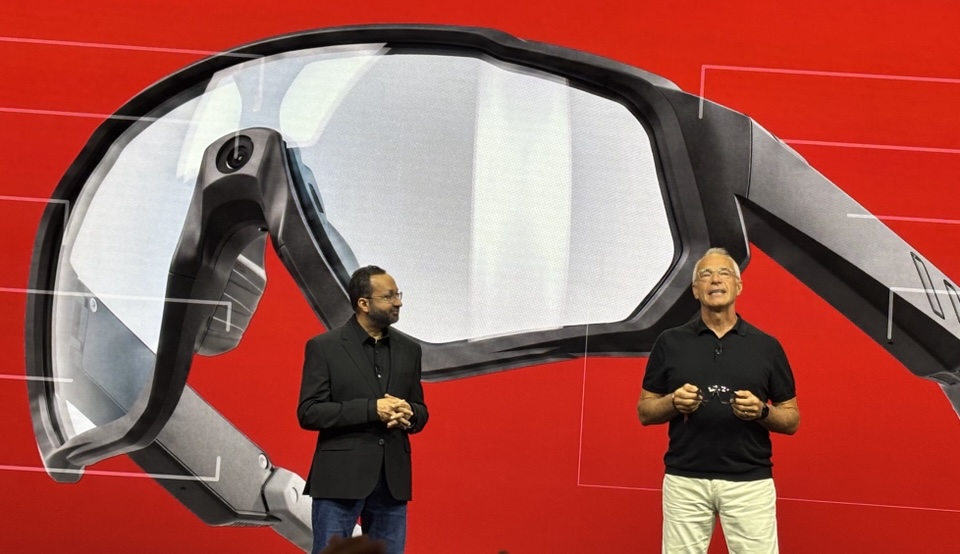
[Maui, United States = Digital Today reporter Dae-geon Seok] Qualcomm AI glasses are moving into factories and exam rooms. They are emerging as an option for workers and medical staff who cannot take their hands or eyes off tasks and find screen-based devices hard to use. On Sept. 23 local time at the Snapdragon Summit, Qualcomm unveiled industrial safety glasses with a camera and AI together with INSPECS and announced the formation of a wearable alliance for the medical sector.
Cameras are already used as tools at industrial sites. Robin Totterman (로빈 토터만), founder and chairman of INSPECS, said in a keynote that a camera is not a new device in factories, oil drilling facilities and laboratories. He said it is already trusted and part of how people work.
INSPECS is an eyewear maker that has its own factory and designs and mass-produces glasses. Totterman said hundreds of millions of people put on safety glasses in line with rules before starting work. He described industrial safety glasses as the world’s largest mandatory eyewear base. That means AI functions can be added to glasses people already wear without having to persuade users separately. ㅇ
INSPECS safety glasses add a camera and AI to that user base. Workers take inspection photos without putting down a wrench. Experts in remote locations watch the same video and guide repairs in real time, and managers who are not on site receive exactly what the worker sees. Workers ask AI questions by voice during tasks and carry out complex work with step-by-step guidance. Ziad Asghar (지아드 아스가르), Qualcomm senior vice president and head of XR, Wearables and Personal AI, said wearables such as AI glasses and AI pins can help with access to information and recording context in offices and industrial sites, education and healthcare.
INSPECS unveiled its first product, the Enterprise Frame. It put a camera, multiple microphones, speakers, voice and touch controls, and a high-capacity battery into an impact-protection frame, and it meets the same safety standards as standard safety glasses. It also showcased a model without a camera. Qualcomm invested in INSPECS in June and provided the Snapdragon AR1+ Gen 1 platform, AI software and reference designs. Totterman said nobody will wear glasses that hurt after 2 hours, and comfort and safety tests for hazardous environments were the tougher challenges. He added that neither an eyewear company nor a chip company could do it alone.
An AI glasses model that adds hearing assistance functions to prescription lenses connects with the medical field. Totterman said glasses long ago shed their image as medical devices, but hearing aids did not, explaining why it put hearing assistance into glasses.
Qualcomm is expanding the same hands-free approach into healthcare settings. At this Snapdragon Summit, Qualcomm presented uses in which medical staff receive real-time guidance based on patient consent without taking their eyes off the patient, and elder care detects changes in condition earlier. It said it formed the Personal AI Health Alliance, which includes medical and technology companies, to make that happen. It said the goal is to address urgent unmet needs in healthcare using on-device personal AI.
In an introductory video released by Qualcomm, examples included a wearable that predicts fall risk before an accident and ambient AI that automatically records clinical consultations. In the video, a medical figure pointed out that doctors turn their backs on patients to enter electronic medical records and continue documentation work after hours. In both examples, data is processed on the device to protect personal information.
Qualcomm plans to soon release clinical trials, solutions and real-world applications as the alliance’s next steps. In industrial settings, INSPECS safety glasses, the first device from the Qualcomm wearable support program, will begin deployment first. Asghar said it is only the start and it will soon share clinical trials and real-world use cases. He said there is potential to do a lot of good in the field.
 Dae-geon Seok
d2dg@d-today.co.kr
Dae-geon Seok
d2dg@d-today.co.kr