
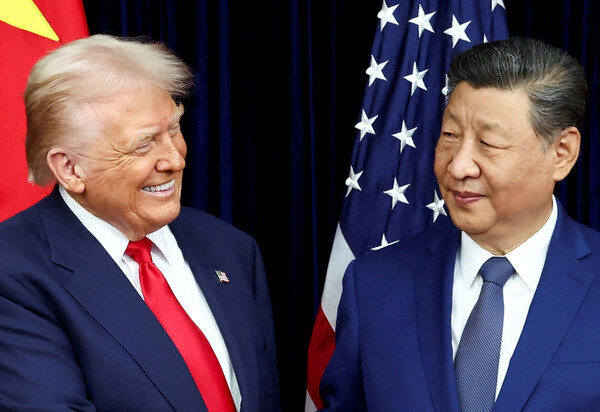
South Korea's stock market is heading into the Chuseok holiday as attention turns to a U.S.-China summit. As results are expected during the holiday, an analysis says investors should distinguish sector-specific impacts of tariffs, semiconductor export controls and rare earth supply chains, while also watching oil prices and changes in U.S. interest rates.
The financial investment industry said on Sept. 23 that U.S. President Donald Trump and Chinese President Xi Jinping will hold a summit in Washington on Sept. 24 local time. Key issues include extending a trade truce that expires in November, cutting tariffs on non-sensitive items, expanding rare earth supplies and holding talks related to artificial intelligence (AI).
Ahead of the summit, the domestic market is caught between expectations of gains led by semiconductors and caution ahead of the holiday. The KOSPI has risen for four straight sessions since Sept. 18, regaining the 7,000 level. Still, a pattern of early strength followed by reduced gains late in the session has continued, suggesting caution about further rises.
How much uncertainty over tariffs and export controls is resolved at the summit is seen as a variable that could determine the market's direction after the holiday.
In tariff talks, the length of any truce extension and the items covered are important. If additional tariffs are delayed or tariffs on some items are lowered, uncertainty over trade and corporate costs could ease.
Brokerages are placing more weight on maintaining the existing truce and specifying some trading terms than on a broad resolution of the conflict.
Moon Nam-joong (문남중), a researcher at Daishin Securities, analysed that even if the summit remains at a general level, extending the trade truce would reaffirm a stance of managing conflict between the two countries. If disagreements over an extension emerge or additional regulations are presented, investor sentiment could weaken, particularly in export-related stocks.
Semiconductors need to be viewed by separating AI cooperation from advanced chip export controls. Even if talks proceed on AI accident response and safety, it is hard to conclude that restrictions on exports to China of advanced AI semiconductors or manufacturing equipment will be eased.
Kim Doo-eon (김두언), a researcher at Hana Securities, also said an AI safety dialogue could begin, but controls on advanced semiconductors are likely to remain as a separate national security barrier.
If the scope of allowed sales to China by U.S. semiconductor companies widens, expectations of stronger demand could be reflected in shares of South Korean companies related to memory chips and high-bandwidth memory (HBM). The impact, however, will vary depending on product specifications allowed and supply relationships.
If regulations remain, the key will be whether memory prices, shipments and customer orders can support share prices more than expectations for the summit.
Lee Jae-won (이재원), a researcher at Yuanta Securities, focused on references related to AI and advanced chips rather than a major trade deal. Adjustments in Nvidia's sales to China or in AI safety rules are important for domestic semiconductor investment sentiment, he analysed, and avoiding a further escalation in conflict is positive for risk assets even without a big agreement.
Rare earth negotiations are linked to risks of production disruptions for automobiles and related parts. If export licences for rare earth magnets become smoother and actual supply increases, the burden of procuring motors and parts could ease. That is why investors need to check not only announcements of easing supply-chain uncertainty but also whether licensing processing times and shipment volumes improve.
For automobiles and batteries, competitive variables also matter. If an agreement expands Chinese companies' access to the U.S. market, the relative advantage of South Korean companies could weaken.
For these sectors, investors need to consider both the positive effect of supply-chain recovery and the possibility of intensified competition. It means progress in negotiations cannot easily be interpreted as a positive for the entire sector.
For power equipment, investors should look at U.S. data centre and power grid investment trends along with the summit outcome. Even if AI investment expansion continues, results will depend on how quickly order backlogs turn into actual revenue and whether rising costs can be reflected in selling prices. For both semiconductors and power equipment, a process is needed to confirm whether diplomatic agreements translate into company orders and profits.
During the Chuseok holiday, Middle East developments and international oil prices are also variables, in addition to U.S.-China negotiations. Even if U.S.-China relations improve, renewed rises in oil prices driven by heightened military tension in the Middle East could weaken the summit's effect by adding to inflation and interest-rate burdens. Conversely, if stable oil prices ease inflation concerns and lower market interest rates, it could reduce the valuation burden on growth stocks such as AI and semiconductors.
By sector, investors should examine whether burdens from airline fuel costs, insurance premiums and transportation costs actually ease. In sectors such as pharmaceuticals and biotech, where expectations of future growth are heavily reflected in share prices, it is important not only to watch long-term U.S. interest rates but also whether corporate funding conditions stabilise.
Han Ji-young (한지영), a researcher at Kiwoom Securities, cited U.S.-China summit developments, U.S.-Iran diplomatic talks and changes in cargo volume through the Strait of Hormuz as variables to monitor during the holiday.
While the domestic market is closed, overseas markets may price in the summit outcome and follow-up remarks. When domestic trading resumes after the holiday, accumulated changes could be reflected in opening prices all at once.
Investors need to check how exposed their holdings are to tariffs and export controls and whether the burden from price swings has increased due to leveraged investments such as margin loans.
Still, this does not mean investors should sell stocks across the board only because of holiday uncertainty. Han suggested a strategy of maintaining exposure to AI infrastructure-related sectors such as semiconductors and power equipment, and to shareholder-return sectors such as banking and insurance, rather than increasing cash holdings further.
The point is that even after the holiday, investors should confirm through U.S. inflation indicators and semiconductor company results whether expectations for the summit lead to an actual improvement in investment conditions.
Kim said, "The market should look at the truce period, volumes, delivery timing and tariff exemption conditions rather than the rhetoric of a joint statement," and added, "Companies that turn promises into orders and profits fastest, rather than sectors that received the biggest promises, are the real beneficiaries of this summit."
 Sang-yeop Oh
yub@d-today.co.kr
Sang-yeop Oh
yub@d-today.co.kr