
Toyota has begun mobilising employees to train humanoid robots for factory work. Toyota's policy is to build a production environment where robots and people work together, rather than directly replacing human labour even as it deploys robots on a large scale.
On Sept. 22 (local time), IT outlet Ars Technica reported that Toyota plans to invest $6.42 billion a year from 2028 to expand factory automation and the introduction of robots. In the long term, it is pursuing a plan to deploy about 400,000 robots across the group. The 400,000 includes both humanoid and non-humanoid robots.
Under the plan, Toyota will deploy 150,000 robots at its auto plants and 250,000 at group facilities that produce parts and materials. Toyota has not disclosed how many robots it has actually deployed so far or what share of the robots to be introduced will be humanoids.
Toyota has already put some "Ereii" humanoid robots on assembly lines to learn on-site work. Ereii, which moves on wheels, is being developed to perform tasks that require precise hand movements. Employees are wearing a "jig" that mimics a humanoid's finger structure to teach the robot how to do tasks.
The large-scale introduction of robots is also raising concerns that the role of human labour will shrink. Toyota has 18,000 skilled workers at 60 plants worldwide and operates 11 production bases in the United States. Hiroki Nakajima (나카지마 히로키), a Toyota senior vice president, said the goal of introducing robots is "a world where robots coexist with humans, not replace them."
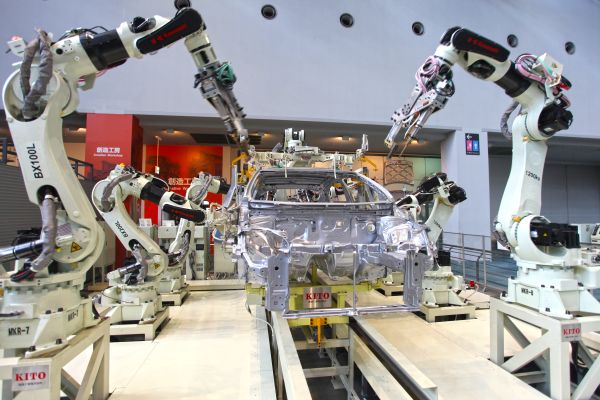
Industrial robots are not new technology in the auto industry. Fixed robotic arms on workbenches and mobile robots that move parts and materials have been used mainly. More recently, competition to develop humanoids is gaining momentum as general-purpose robots that can be easily deployed in work environments designed for people and can perform a range of tasks.
Challenges remain before humanoid robots can spread on a large scale. Beyond the performance of artificial intelligence and robot hardware, safety when working with people, operational issues and production costs must be addressed. It is also still uncertain how much more cost-efficient humanoid robots are compared with hiring people. Robot makers have only recently begun to seriously try mass production of humanoids.
Even so, the auto industry's adoption of robots is expected to keep expanding. Carmakers are reorganising assembly lines for production of new vehicles, including electric vehicles, that incorporate more computers and semiconductors. At the same time, they must respond to shortages of some skilled workers and an ageing workforce. Labour groups are also pushing back, saying the adoption of robots and AI could lead to layoffs and pressure on wages and working conditions.
Other automakers are also moving to introduce humanoid robots. Chinese electric vehicle makers Xpeng and Nio are developing their own humanoids or investing in related technology. Hyundai Motor Group plans to deploy the "Atlas" humanoid developed by its U.S. robotics affiliate Boston Dynamics at factories from 2028, and aims to place up to 25,000 units at Hyundai Motor and Kia production facilities over the next few years.
Boston Dynamics opened a robot training centre on Sept. 21 at Hyundai Motor Group Metaplant America in the U.S. state of Georgia. The facility was designed so Atlas can learn tasks such as arranging auto parts in sequence and placing parts needed for assembly in the correct order.
As Toyota pursues plans to deploy robots, including humanoids, on a large scale at production sites, it has entered a stage of having robots learn the skilled techniques of human workers. The actual scale of deployment, the share of humanoids and the specific division of roles between humans and robots are expected to be disclosed later.
 Yu Seung-a
ysah@d-today.co.kr
Yu Seung-a
ysah@d-today.co.kr