
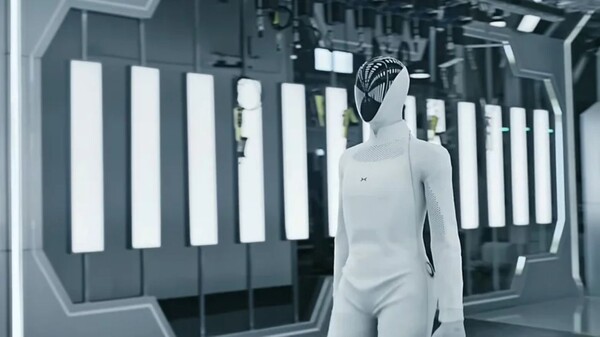
China electric vehicle maker Xpeng has started a new production line for its humanoid robot Iron and released footage showing the assembled robot walking out of the line on its own. Xpeng set a goal of entering mass production of Iron by the end of this year.
On Sept. 22 (local time), IT outlet Engadget reported that Xpeng officially announced on Sept. 7 that it had launched the humanoid robot production line. Xpeng has automated more than 80 percent of key processes on the line. It plans to apply the quality-control system it built in its car business to robot production to ensure consistent quality as output increases.
He Xiaopeng (허샤오펑), chairman and chief executive officer of Xpeng, said, "Today's step is small, but Xpeng is building a production line for a completely new product line." Xpeng released footage of Iron walking off the production line after manufacturing without separate remote control, stressing that it has moved from the research and development stage to the production-line manufacturing stage.
The demonstration alone did not confirm Iron's actual on-site performance. Xpeng did not disclose the current output capacity of the production line or how much testing was conducted ahead of the walking demonstration. With mass production targeted within the year, the actual production scale and performance in commercial environments need additional verification.
Xpeng also presented initial uses for Iron. Iron will first be deployed at Xpeng's own stores and campus to handle customer guidance, conduct tours and assist with sales. Official launch and deliveries in China and overseas markets are planned for 2027, but it did not disclose whether it will be released in the United States or its price.
Hardware and computing performance were also disclosed. Xpeng said Iron has 76 degrees of freedom (DOF) across its body and 21 DOF in each hand. DOF refers to the number of axes a robot can move independently. Based on this joint structure, it is designed to walk and move objects in spaces used by people.
Iron is equipped with 3 Turing artificial intelligence chips, providing up to 2,250 TOPS of computing performance. Xpeng explained that this enables Iron to run AI models directly on the device and perform complex tasks without remote control. On-device computing can reduce latency, but it is difficult to judge how well it can handle various real-world situations based on computing performance alone.
Safety is also a task that must be addressed in commercialisation. Xpeng said it designed Iron's external structure with flexibility and safety in mind. It did not disclose independent safety evaluation results in the announcement. As it plans to use the robot for direct interaction with customers, stable operation in real environments is important.
Xpeng's move aligns with a trend of EV makers extending car manufacturing and AI technologies into humanoid robots. Tesla is also pursuing a plan to convert Model S and Model X production lines to produce Optimus. It is too early at this stage to directly compare the two companies' humanoid robot production and performance.
There are also cases where humanoid robots have been deployed in actual production sites. Figure AI said in April it produced more than 350 Figure 03 robots and demonstrated a production cycle of 1 unit per hour. The robots included units used for internal development and data collection, so they cannot be interpreted as units for customer delivery.
At BMW, Figure AI's previous-generation robot, Figure 02, performed actual production work at the Spartanburg plant in South Carolina. Figure 02 handled repetitive tasks of picking and moving sheet-metal parts needed for welding processes and supported production of more than 30,000 BMW X3 vehicles over 10 months. BMW said the robot worked 10-hour shifts, moved more than 90,000 parts and operated for about 1,250 hours.
Ultimately, the next point to watch for Xpeng is not the scene of a robot walking out of the production line itself but the scale of mass production and results from on-site deployment. Key variables for commercialisation will be how stably Iron can perform in real operating environments such as stores and campuses, and how far Xpeng can achieve its mass-production target within the year.
 Seung-a Yoo
ysah@d-today.co.kr
Seung-a Yoo
ysah@d-today.co.kr