
[Maui, United States = DigitalToday reporter Seok Dae-geon] Qualcomm is fleshing out a vision of an “AI smartphone” in which AI agents, rather than apps, take user intent and carry out tasks. As mixture-of-experts (MoE) models, orchestrators and the MCP protocol spread, agents can link multiple apps and services and complete tasks on behalf of users. Qualcomm said next-generation agentic AI devices can process up to 1 million tokens a day on-device.
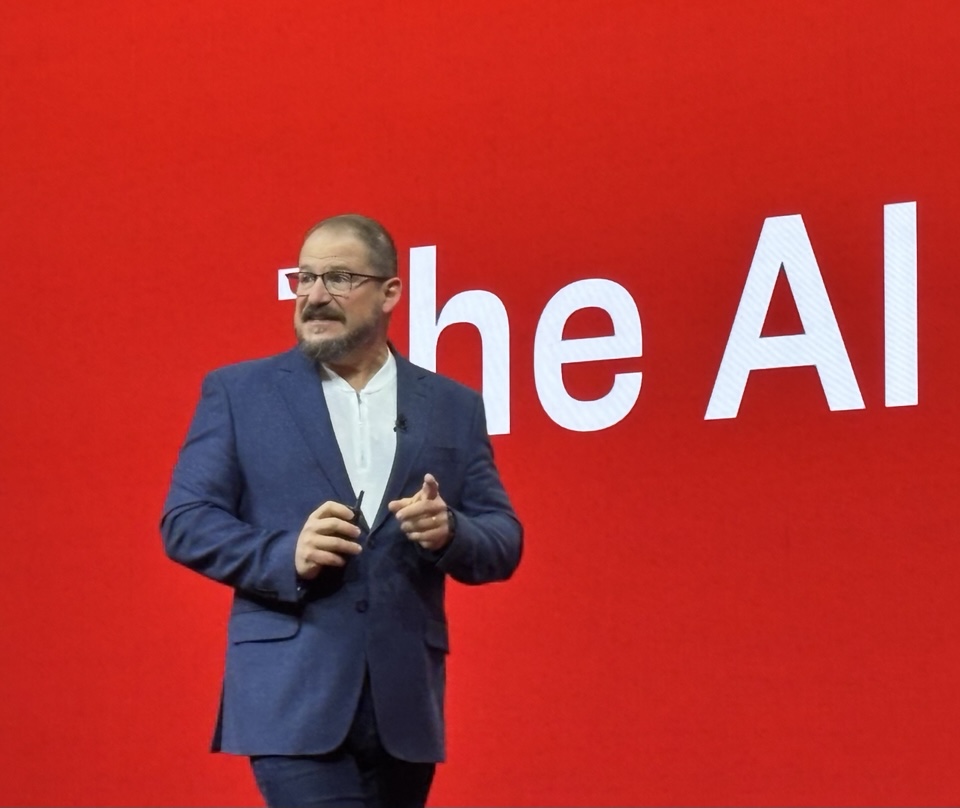
Qualcomm CEO Cristiano Amon (크리스티아노 아몬) said in a keynote speech at Snapdragon Summit 2026 in Maui, Hawaii, on Sept. 22 local time, “It is now clear what an AI smartphone is,” adding, “We are moving from apps and assistants to agents.” He said the model is shifting from users opening apps one by one to perform tasks to agents handling tasks for them.
Qualcomm sees smartphones remaining a core device even in the era of agentic AI. Amon said, “Phones are not going away,” and pointed to phones as the device that knows the user best. For agents to work properly, they need user context, and the device that holds the most user information is the smartphone people always carry, he said.
Over the past 20 years, smartphones have provided functions at the app level, but agentic AI devices take user intent as input. In addition to users directly operating devices, agents analyze situations, make plans and execute tasks on behalf of users. For this, agents must have access to personal information and user-granted permissions, persistent context, real-time reasoning and multimodal capabilities that handle language, vision and voice together.
Qualcomm presented trust and convenience as the criteria users will use to decide whether to use agents. Because agents act on behalf of users, security and privacy protection must be ensured and control must remain with the user. Qualcomm also cited as a condition that using an agent must be easier than doing it directly. It explained that e-commerce moved from laptops to mobile because mobile was easier.
For example, an agent can notify a user about a concert by a favorite band, and if the user replies “yes,” the agent handles schedule coordination, ticket purchases and planning. In this process, the user does not personally connect multiple apps, cloud services and models.
Qualcomm plans to expand agents to devices beyond smartphones. Agents can be used on PCs, smart glasses, wearables and in cars, and users would choose the most convenient device depending on location and need. Tasks are split across computing resources on devices and in the cloud. Qualcomm introduced that adoption of Snapdragon is increasing in personal AI devices such as smartwatches and glasses, pendants and pins.
◆ Preview of a ‘coprocessor’ combining memory and AI compute
At the same time, Snapdragon design requirements are also changing. As agents execute tasks even when users are not using their phones, the situation itself has changed. Amon explained that the company must solve again challenges similar to those with the first Snapdragon 8, when it had to run an advanced operating system all day at a 1 GHz clock speed.
The CPU that handles agent orchestration, the NPU responsible for efficient AI inference, and the GPU responsible for parallel processing must be designed together with connectivity. Requirements that the phone must fit in a pocket, produce little heat and last all day on battery remain the same in the AI era. Because devices run on batteries, heterogeneous computing designs with specialized compute engines for each task will continue to be needed, Amon stressed.
To address this challenge, Qualcomm applied data-center technology to smartphones. Based on a data-center compute engine that improves efficiency by linking memory and accelerators, it developed a Snapdragon coprocessor that places memory close to AI compute devices. Qualcomm expects the daily token throughput of agentic AI devices to increase further. The coprocessor is seen as a device to handle rising AI compute within battery life. Amon said the company plans to expand the technology “to laptops, smart glasses and cars, among others.”
 Seok Dae-geon
d2dg@d-today.co.kr
Seok Dae-geon
d2dg@d-today.co.kr