
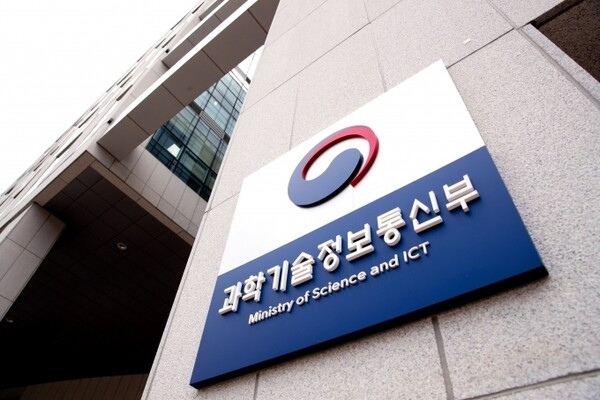
The Ministry of Science and ICT's AI Policy Office, which oversees the ministry's AI policy, has entered a second phase with the appointment of a new director. The office has so far laid the groundwork for a push to become one of the world's top three AI powers, including securing high-performance graphics processing units and developing a homegrown AI foundation model project. Under the new director, more weight is expected to be placed on connecting this to tangible industrial and service outcomes.
According to the ministry on Sept. 22, new AI Policy Office chief Yeol Um (엄열) officially began work on Sept. 21. The AI Policy Office is a dedicated AI organisation created during last year's government reorganisation. It oversees related policies including AI policy and industry promotion, computing infrastructure, data, and safety and trust.
Former chief Kyung-man Kim (김경만) moved to head the support group of the presidential National AI Strategy Committee. Um became the second head of the AI Policy Office after being promoted from science and AI policy cooperation officer to director.
◆ First-phase AI Policy Office that set the stage for GPUs and homegrown AI models
The first-phase AI Policy Office led by Kim focused on building the foundation for the top-three AI push. It was tasked with putting large government projects on track, including securing GPUs, the Dokpamo project and expanding AI computing infrastructure. After Deputy Prime Minister Kyung-hoon Bae (배경훈) took office, it sped up efforts to secure infrastructure and strengthen domestic AI capabilities. It also prepared an institutional foundation to respond to AI diffusion, including the AI Basic Act that took effect in January. The Dokpamo project has completed its second-stage evaluation and has entered a phase of judging its actual competitiveness.
With Bae marking more than 1 year in office, there is also a mood across the ministry's AI policy that places greater emphasis on "results". Against that backdrop, Um's selection is seen as a choice to maintain continuity while boosting execution. Um was also named among candidates for the first director when the AI Policy Office was launched last year.
Um, a 40th class civil service exam graduate, has broad experience within the ministry in expanding AI industry and services and in infrastructure policy. After becoming director general for AI-based policy in 2022, he handled policies to strengthen competitiveness in large-scale AI. Major policies such as the government's "AI daily life for all citizens" action plan and expanding domestically produced AI semiconductors also went through Um.
He later served as director general for telecommunications policy and was involved in AI computing infrastructure policy. As science and AI policy cooperation officer, he was responsible for institutional improvements to expand AI data centres and for cross-ministry policy cooperation. Last year, he supported work to enact a special law on AI data centres that included steps such as reducing licensing and permitting procedures in the process of building AI data centres.
◆ Dokpamo, AI for Everyone and AI data centres: a pile of tasks to deliver results
The second-phase AI Policy Office also faces many immediate issues to resolve. The Dokpamo project must create new evaluation and development standards to expand into frontier AI models. The "AI for Everyone" project to deliver public-facing AI services is also approaching the release of beta services by each consortium. It is also time to produce visible results in a security-focused AI specialised model project and in physical AI, one of the core elements of the three mega-projects for South Korea's leap forward.
An AI industry official said, "In a situation where technology advances day by day, it is time to show with our own eyes real outputs for becoming a top-three AI power." The person added, "In particular, there is a need to manage things so that noise does not arise in projects involving companies, such as Dokpamo."
Expanding AI data centres is also a task that needs to pick up speed. The government launched an AI data centre alliance and began work to link related ecosystems such as data centres, semiconductors, cooling and power. Large-scale AI data centres require stable supplies of massive electricity. There are many issues that are difficult for the Ministry of Science and ICT to resolve alone, including securing power grids, regional dispersion and permitting.
Cooperation among organisations responsible for government AI policy is also being tested. The structure has the Ministry of Science and ICT in charge of AI industry and project execution, while the National AI Strategy Committee performs cross-ministry strategy and coordination. With former chief Kim moving to lead the committee's support group, understanding of the homegrown AI model, computing infrastructure and AI for Everyone projects pushed by the ministry can be carried into cross-ministry policy coordination.
Another industry official said, "Now, more than the expression top-three AI power itself, this is the time when we need concrete numbers and cases to support it." The person added, "Outputs such as where domestically produced models are used, investment in AI data centres and physical AI demonstrations will become the standard for evaluating policy."
 Jin-ho Lee
jhlee26@d-today.co.kr
Jin-ho Lee
jhlee26@d-today.co.kr