
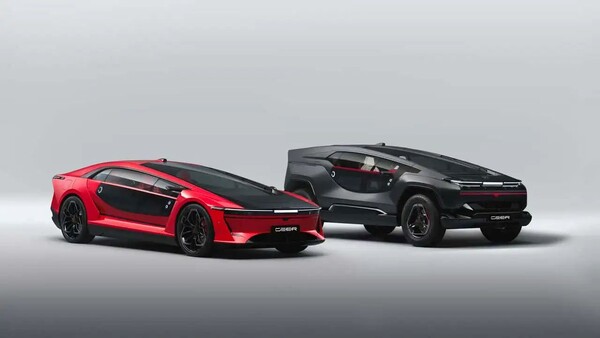
Saudi Arabia has moved in earnest to foster its auto industry, led by Ceer, the country’s first domestic full-vehicle maker.
On Sept. 21 (local time), overseas media including Ars Technica reported that Ceer unveiled two electric models, a sedan and an SUV, and has positioned itself as a key manufacturing project under Vision 2030, a national strategy to reduce dependence on oil. Ceer is a joint venture between Saudi Arabia’s sovereign wealth fund, the Public Investment Fund (PIF), and Foxconn.
The flagship vehicles unveiled are the Exobot sedan and SUV. Ceer said the two models set the direction for its future product lineup and it plans to expand its portfolio to 7 models by 2030. Some models will be hybrids.
The Gulf Cooperation Council (GCC) region is at the centre of its initial strategy. Ceer said it can expand into other markets if demand is confirmed, based on product competitiveness. It said it developed the vehicles so they can quickly obtain certification in global markets such as Europe and North America. Overseas sales expansion is not confirmed, but it said the vehicles were designed from the start with global standards in mind.
Ceer’s differentiators are high performance, a digital user experience and local production. The Exobot has a 112-kilowatt-hour (kWh) battery pack. Driving range, based on the older NEDC standard rather than the newer WLTP, is more than 500 km for the SUV and more than 600 km for the sedan. It applies an 800-volt electrical architecture and can charge the battery to 80 percent in about 30 minutes with fast charging, the company said.
Performance figures are also aggressive. At the launch event, the Exobot was presented with a peak output of 1,111 horsepower and maximum torque of 1,500 Nm, along with a tri-motor-based torque vectoring system. The sedan takes slightly more than 2 seconds to accelerate from a standstill to 100 km per hour, while the SUV takes 2.4 seconds. Air suspension is also offered as an option.
The interior is built around large displays. It has a 48-inch digital display spanning the dashboard, a 10.4-inch central control screen and an 8-inch rear-seat screen. The vehicle software uses an in-house intellectual-property-based infotainment system developed jointly with Foxconn and others. Markus Leitner (마르쿠스 라이트너), Ceer’s chief technology officer, said it will support Apple CarPlay and Android Auto from launch. It was designed to allow performance and driving range improvements through wireless software updates.
The vehicle design incorporates Saudi identity. The front and rear light bars use 32 independent elements, reflecting 1932, when Saudi Arabia was unified. It also applied glass with electrically adjustable transparency, "Shaheen Wing" doors and a "Halo Cooling" function for high-temperature environments.
Executives said they were instructed from the design stage to take a different direction from existing automakers. James DeLuca (제임스 델루카), Ceer’s chief executive officer, said the Saudi crown prince told them in an initial design briefing to look at existing products but go in a different direction. Quoting the crown prince, DeLuca said, "If the world goes left, we go right."
He also expressed confidence in its technological competitiveness. Leitner said, "Everyone does tri-motors, everyone does torque vectoring and everyone uses air suspension," adding that Ceer’s strength lies in integrating them to enhance the driving experience.
Ceer’s industrial significance goes beyond vehicle sales to building a production ecosystem. The company plans to build a dedicated production complex in King Abdullah Economic City north of Jeddah and to cluster partner firms nearby. If the plan proceeds as intended, it expects 35,000 direct and indirect jobs to be created by 2034. The Saudi government is encouraging local production of products for domestic use through its "Saudi Made" policy, and Ceer is being promoted as a representative manufacturing project.
Key points to watch are price competitiveness of mass-market models and the domestic market response. As Ceer’s first two models are flagship vehicles with strong symbolism, a central issue will be how competitive its future main mass-market cars will be compared with Chinese brands sold in the Saudi market.
 Seung-a Yoo
ysah@d-today.co.kr
Seung-a Yoo
ysah@d-today.co.kr