
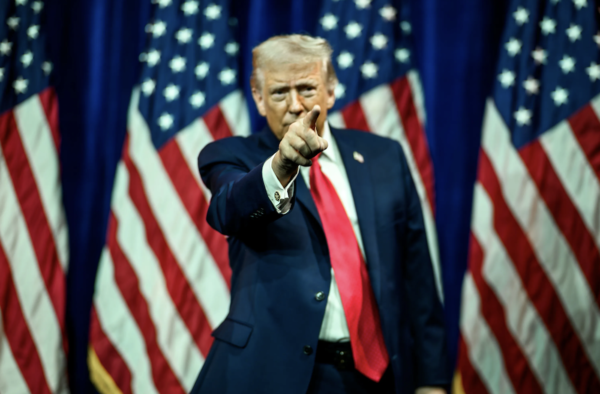
U.S. President Donald Trump said he is pushing to create an “AI Force” and appoint a new AI czar.
On Sept. 21, local time, major foreign media outlets including blockchain news site Cryptopolitan reported that Trump laid out a plan to make AI a core growth engine of the U.S. economy, placing emphasis on promoting the industry rather than regulating it directly.
In a post on his Truth Social account, Trump compared the AI Force to the Space Force he created during his first administration. He also said he would appoint an AI czar. The White House AI czar position has been vacant for months. Trump nominated venture investor David Sacks in December 2024 as White House AI and crypto czar, but Sacks said in March 2026 that his term as a special government employee had ended.
Trump also made clear his position that Washington’s role is to grow the industry and that illegal acts can be handled by the existing judicial system. On the AI industry, he wrote, “We will not in any way hinder or suppress the growth of this amazing industry,” adding, “Rather, we will cherish it, help it, and watch it grow.” He then argued that problem actors can be dealt with “very easily” through the existing criminal and civil justice system.
The key point is putting AI at the center of national competitiveness. Trump likened AI to “the next industrial revolution, or the internet,” while saying it could have an even bigger impact. With the United States competing with China, he also said AI “could account for as much as 25 percent of U.S. gross domestic product (GDP).” At the Doonbeg Golf Club in Ireland, he stressed a competitive edge, saying, “Whoever wins in AI wins.”
Still, debate in the United States over AI risks is growing. Trump dismissed warnings about threatening superintelligence as fiction, but some in the industry and politics are voicing the opposite view. Former Anthropic researcher Jacob Coxon criticised Anthropic and OpenAI on Sept. 8, saying they are gambling with people’s lives by pursuing self-improving superintelligence. Dario Amodei, Anthropic’s chief executive, also said AI carries real risks and that the industry misled the public about technological risks.
Personnel appointments within the administration have also not yet been fully settled. Chris Fall, who led the AI Standards and Innovation Center under the Commerce Department, resigned in July after about 3 months. Arvind Raman, head of the National Institute of Standards and Technology, has since been serving as the center’s acting lead. With the White House AI czar post still vacant, the new appointments Trump has foreshadowed have become more likely to shape the direction of future AI policy.
In Congress, legislation to add safety guardrails is also moving in parallel. Senators Amy Klobuchar, Ted Cruz and John Thune are preparing a bipartisan bill that would impose a legal duty of care on advanced AI developers. The bill also includes provisions that would allow the government to block the release of unsafe models. House Speaker Mike Johnson said, “Some guardrails, some safety measures are needed,” and House Democratic leader Hakeem Jeffries urged that “Congress must act urgently.”
Against this backdrop, U.S. AI policy is developing into a structure in which the administration’s growth-first approach and congressional discussions calling for safety regulation unfold at the same time. With Trump reaffirming his stance that he will push AI as a strategic industry, the selection of a new AI czar, whether to proceed with an AI Force, and Congress’ safety legislation are expected to become key variables in future policy clashes.
 Jinju Hong (홍진주)
hongjj@d-today.co.kr
Jinju Hong (홍진주)
hongjj@d-today.co.kr