
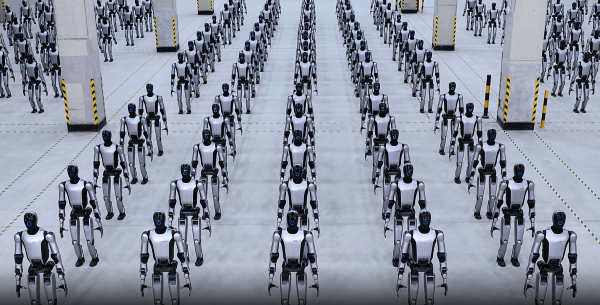
About 7,000 humanoid robots were sold worldwide last year. But many were used less in actual industrial workplaces than by research institutions or for securing data to develop artificial intelligence (AI) models.
On Sept. 21 (local time), Reuters reported that the International Federation of Robotics (IFR) counted about 7,000 humanoid robots sold worldwide in 2025 for industrial and professional service use. The IFR has compiled robot statistics for 30 years, and this was the first time it counted humanoids as a separate category.
Susanne Bieller (수잔 비엘러), secretary general of the IFR, explained that the main buyers of humanoids last year were research institutions and companies seeking to generate data to improve AI models, rather than companies looking for workers to replace people.
Adoption by automakers also remains closer to experimentation than a large-scale shift. Bieller said most pilot projects in automakers' factories involve "single-digit or sometimes double-digit numbers of robots."
A similar pattern appears at individual companies. At Chinese robotics company Unitree, about 75 percent of humanoids sold last year were sold to universities, research institutions and individual developers. That means humanoid sales volumes themselves do not show how much they are being used at actual production sites.
The IFR defines humanoids as robots whose appearance is generally similar to humans and that can work autonomously in environments designed for human use. They do not necessarily have to walk on 2 legs. The IFR used data from robot makers and suppliers and national industry associations, and excluded consumer and military humanoids. Medical robots are classified in a separate category.
Caution is also needed when simply comparing shipments by company. That is because shipment figures presented by companies such as Unitree and AGIBOT may apply different definitions, supplier samples and counting periods. A higher or lower figure at one company does not necessarily conflict with another company's figure.
Above all, it is difficult to judge the actual level of humanoid use based on sales alone. Sales totals do not show how many of the robots sold are actually operating, how often they are used, or whether they create enough value to justify the cost.
Humanoids still account for a small share of the overall robot market. The IFR said about 542,000 conventional industrial robots were installed worldwide in 2024, and about 199,000 professional service robots used for transport, hotels and cleaning were sold. Bieller explained that the roughly 7,000 humanoids sold in 2025 are "only a small part" of the overall global robot market.
The IFR plans to release total statistics for industrial and service robots in 2025 on Sept. 24.
Market forecasts are far larger than current sales. Bank of America Global Research forecast humanoid shipments of 90,000 units in 2026 and 1,200,000 units in 2030. The 2026 forecast is about 13 times the 2025 sales volume counted by the IFR, but there are limits to a simple comparison because the two figures use different counting methods.
China is cited as a centre of humanoid market expansion. China is already the world's largest industrial robot market, and at a government-backed robot competition in August, humanoids demonstrated running and boxing. China's National Development and Reform Commission also announced a state-led venture capital fund expected to attract about 1 trillion yuan, or about 204.2 trillion won, over 20 years for advanced industries such as robots and AI.
Still, the humanoid market is at a stage where it must prove whether pilot projects can lead to adoption in large-scale commercial and retail markets. The analysis said annual sales may remain closer to about 7,000 units in 2025 than the 90,000-unit forecast for 2026 until companies begin placing large humanoid orders.
 Seung-a Yoo
ysah@d-today.co.kr
Seung-a Yoo
ysah@d-today.co.kr