
[Digital Today reporter Seulgi Son] "At shipyards in Gyeongsang Province, people pronounce 'tank' as 'ttaengkeu' when they mean a water tank, but generic engines often take it as 'thank you'. People on site say they clearly said 'tank' and ask why the machine cannot understand."
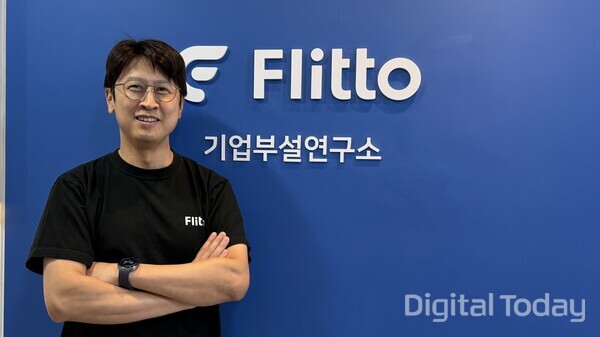
Flitto co-founder and chief technology officer Kang Dong-han (강동한) explained this on Sept. 21 in an interview at the company's in-house research institute in Seoul's Gangnam district, describing why it is difficult to apply generic AI as-is at industrial sites.
Frontier AI from global big tech companies such as OpenAI and Google is advancing rapidly. But on actual manufacturing floors, factors such as regional accents and dialects, workers' slang and technical terms, and machine noise come into play. Kang said in areas that require specialised data, such as manufacturing sites, customised models tailored to the workplace can respond faster and more accurately than general-purpose frontier AI. He said interpretation and translation quality ultimately depends on how quickly AI is "localised" for the site.
Kang said, "If we gathered 20 people who are good at AI globally and said we made the best AI model, nobody would believe it, and I would not either." He added, "Rather than building a frontier model to compete, what we can do well is fine-tune that model to fit the site and provide it in a customised way by adding things like glossaries."
Flitto's AI interpretation and translation service "Otalk", recently built with Hanwha Ocean and Hanwha Systems, applies that strategy to shipbuilding sites. It supports 44 languages including Korean and offers one-on-one and group conversations, as well as text and image translation.
The first problem in development was on-site pronunciation and dialects. Kang said, "In a generic engine, 'clean the tank' came out as 'thank you clinic'." He added, "In an LG Electronics case, there were instances where a word like 'pump' was recognised as 'ppomppu' depending on how on-site workers pronounced it."
Flitto collected voices of speakers similar in age group and region to actual workers, created sentences containing the relevant words and trained the model. To prevent the model from becoming biased toward specific pronunciations and weakening its recognition of standard Korean, it combined workplace-specific data with general data through a replay method, along with fine-tuning and applying glossaries.
Kang said, "If you keep training only on dialects or specific pronunciations, you could actually miss standard Korean that you originally understood well." He added, "It is similar to studying only mathematics and forgetting other subjects." He then said, "One method alone is not enough."
It also adjusted for shipyard-specific noise. It applied a five-level sound input adjustment function so that voice capture could be tuned depending on the environment, such as work areas, break rooms, offices and interview spaces.
Actual usage was also high. During the pilot operation, Otalk usage among Hanwha Ocean's foreign workers reached about 96 percent. As requests from subcontractors continued, it expanded the scope to include subcontractor workers after linking employee ID numbers.
Kang said of the on-site response, "Some say, 'We cannot work without this'." He added, "It is a site where people leave work at 5 p.m., but they use it a lot at night as well." He said it is being used steadily in actual work processes, unlike enterprise solutions that stop at simple deployment.
On-site slang and technical terms are also areas that generic models cannot handle immediately. Hanwha Ocean's existing terms were not enough, so during on-site testing it supplemented the glossary whenever new expressions emerged. Flitto's professional translation team created translations that fit actual usage, and it also built management functions so the client can directly add new terms.
Data secured through a specific company's project is managed separately depending on contract terms. Kang said, "What is common to shipbuilding can become shared knowledge, but data tied to a specific company has no meaning elsewhere." He added, "Data that cannot be taken out under the contract is managed thoroughly, and data that must be destroyed after delivery is destroyed."
Kang said Flitto's competitiveness lies not in any one model but in comprehensive capabilities spanning data collection and refining, training and glossary building. He said, "These days, AI cannot succeed with just one thing, whether it is being good only at speech-to-text or only at translation, or having a lot of glossaries." He added, "Our strength is quickly collecting good, accurate data, training frontier models to fit the site and applying them to actual services."
Based on this, Flitto is also expanding its business to build customised interpretation and translation solutions for companies. After fully scaling its solutions business about 2 years ago, it broadened its business scope to include conference "Live Translation", personal "Chat Translation" and enterprise build-out solutions, and it secured the Hanwha Ocean project this year as a representative build-out case.
Flitto also mentioned the possibility of turning profitable this year in its enterprise interpretation and translation solutions segment. It plans to expand its customer base based on on-site build-out cases such as Hanwha Ocean and to step up its customised enterprise interpretation and translation solutions business from next year.
 Seulgi Son
sageson@d-today.co.kr
Seulgi Son
sageson@d-today.co.kr