
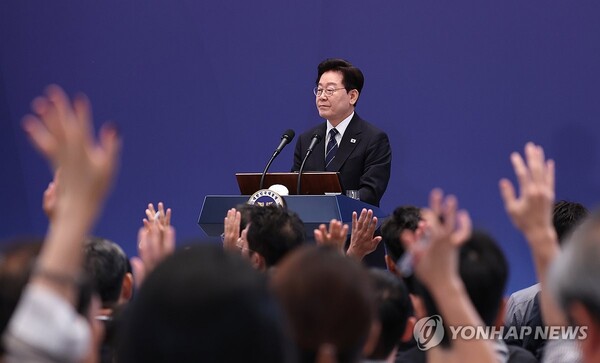
President Lee Jae-myung (이재명) said on Sept. 18 that building semiconductor plants in the United States involves corporate management decisions about how much to expand and is also tied to South Korea's industrial strategy. He said the government will work toward a reasonable conclusion that protects national interests while respecting companies' views.
Lee made the remarks at a news conference at the Blue House state guest house. He said Samsung and SK hynix are already building semiconductor plants in the United States and described the issue as still being debated.
The U.S. government is pressuring South Korean companies to build more semiconductor plants in the United States. U.S. Commerce Secretary Howard Lutnick said on Sept. 2, while reviewing semiconductor tariffs, "If you produce here (in the United States), you do not pay tariffs. If you do not produce here, be prepared to pay the price (tariffs) to enter the greatest market in the world."
There are also reports about the moves of South Korean companies around U.S. production. Reuters reported on Sept. 16 local time that SK hynix is in talks with Intel over producing memory chips in the United States, with an option to lease part of Intel's Ohio plant site seen as likely. It also cited discussion of setting up a joint venture involving Intel and a major cloud company.
SK hynix said nothing has been confirmed at this time. It said it is reviewing various options, including building additional production bases, leaving the possibility open.
Lee also discussed the status of talks over a $350 billion investment package with the United States. He called it a very complex and difficult task and said it has a truly multifaceted impact on South Korea-U.S. relations. He said the $350 billion, about 500 trillion won, is money that amounts to taxpayers' funds and he did not want to do it. He said South Korea ultimately compromised after looking at tariffs, relations with the United States and the details of agreements by nearby Japan, Taiwan and Singapore.
The biggest issue at the time of consultations was whether to include the phrase "commercial rationality" in the agreement. Recalling that time, Lee said there had been no compromise from midnight on the eve of the second summit until 7:30 a.m. the next morning. He said it was included as South Korea wanted and that it was wording not found in other countries' agreements.
But the phrase became an issue again as detailed investment talks began. Lee said South Korea only undertakes projects with commercial rationality and that the law requires screening for commercial rationality. He raised questions over how the money would be recovered, how profits would be shared and how projects that generate losses would be handled.
As a result, an announcement on the U.S. investment that had been planned as early as this week has effectively fallen through. The Ministry of Trade, Industry and Energy was reported to have asked on Sept. 17 to postpone a scheduled briefing to the National Assembly. That is expected to delay the signing of a memorandum of understanding for the first U.S. investment project and the project announcement that were to follow.
Lee cited national interest as the principle guiding the talks. He said the sides say they are close to an agreement, but some parts were not easy to agree to after reviewing the details, and talks are continuing. He said national interest is truly important and should not be swayed by impulsiveness or by pressure or coercion.
He said South Korea is engaged in intense debate and consultations to structure projects so that South Korea's national interests are not harmed and the content benefits both countries.
 Dae-geon Seok
d2dg@d-today.co.kr
Dae-geon Seok
d2dg@d-today.co.kr