
SK Telecom has developed digital twin technology with the Korea Institute of Science and Technology Information (KISTI) to verify the performance and operability of quantum cryptography communications networks.
SK Telecom said on Sept. 22 it unveiled the quantum cryptography communications network digital twin technology it co-developed with KISTI at the European optical communications event ECOC 2026 being held in Malaga, Spain.
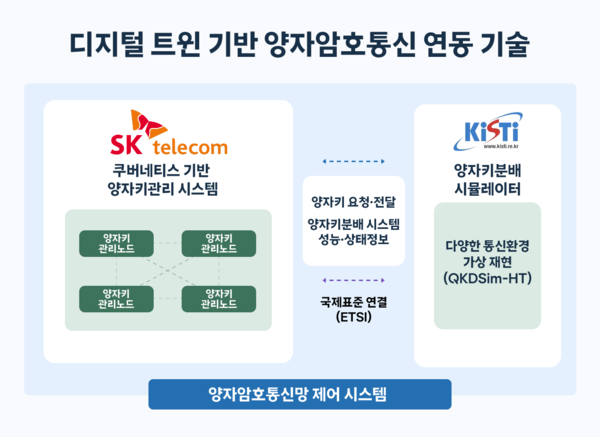
Once a quantum cryptography communications network is built, it is difficult to change the communications environment such as fibre-optic cable length or optical loss, and equipment prices are high, limiting tests of diverse conditions in real environments. The key is that SKT’s quantum key management system and KISTI’s quantum key distribution (QKD) simulator are linked in real time through an ETSI international standards-compatible interface.
Quantum key distribution is technology that generates and delivers encryption keys using the principles of quantum mechanics. When the quantum key management system requests keys, the KISTI simulator implements various communications environments and delivers in real time the quantum keys generated under those conditions along with performance and status information for the QKD system. The virtual environment can reflect not only communication distance and optical loss but also characteristics of actual QKD equipment such as reception efficiency and post-processing algorithms.
SKT implements its quantum key management system on a container basis and deploys and operates it through Kubernetes. This allows the system to be scaled and verified in real time to match various network environments and key management scenarios implemented by the simulator. KISTI developed a QKD simulator that can virtually implement various conditions such as communication distance and optical loss. The quantum cryptography communications network control system links and controls the quantum key management system and the simulator.
The two applied an international standards-compatible interface to reduce dependence on specific equipment or dedicated interfaces. They explained that it can also be linked with quantum cryptography equipment developed by other institutions or companies in the future, improving interoperability and scalability.
Ryu Tak-gi (류탁기), head of network technology at SKT, said, "By linking a Kubernetes-based key management system and a quantum key distribution simulator, we can flexibly verify various network environments and key management functions." He added, "Based on this, we will build an operating environment for a highly scalable quantum cryptography communications network."
Song Jung-seok (송중석), head of the Network Future Technology Research Division at KISTI, said, "We have laid the foundation to implement various quantum cryptography communications environments and verify them by linking with an actual key management system." He added, "We will develop this into a core technology that enhances interoperability and scalability of quantum cryptography communications networks in the future."
 Jin-ho Lee
jhlee26@d-today.co.kr
Jin-ho Lee
jhlee26@d-today.co.kr