
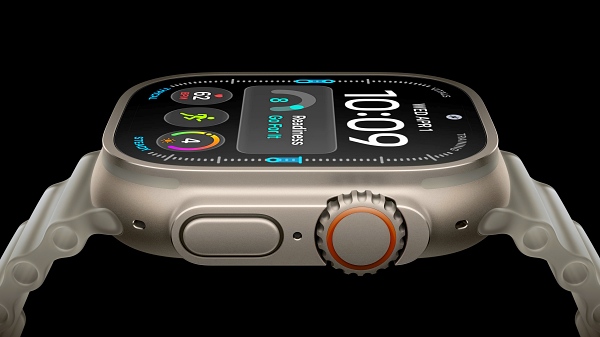
New premium smartwatches from Apple and Samsung Electronics have been released side by side this summer, reigniting competition in the high-end wearable market.
On Sept. 18, IT outlet Engadget compared Apple Watch Ultra 4 and Galaxy Watch Ultra 2. It said the two share many similarities, including titanium materials and support for underwater activities, but differ in screen brightness, battery, health tracking methods and price.
Both are top-tier models that stress activity and durability. Each uses a titanium body. Samsung Electronics offers gray and silver, while Apple offers black and natural colors. Bands also come in neutral and primary tones, with various material combinations. Apple also introduced a Hermes collaboration featuring a titanium band and 2 ocean-themed watch faces.
Durability is designed with underwater activities in mind for both models. Apple Watch Ultra 4 supports IP6X dust resistance, use at depths of up to 100 metres and an EN13319 depth gauge rating. Galaxy Watch Ultra 2 also supports EN13319 and use up to 100 metres underwater, and carries an IP69K dust and water resistance rating. Both target swimming and diving demand, but Samsung Electronics points to a higher dust and water resistance rating in detailed specifications.
Hardware and software clearly diverge. Galaxy Watch Ultra 2 includes a Snapdragon Wear Elite chip, Gemini AI, 64GB of storage and 2GB of memory. Apple Watch Ultra 4 uses an S11 chip and a new Siri, and supports an Audio Intelligence feature that is also included in Watch Series 12. Storage is 64GB.
Displays also differ in direction. Galaxy Watch Ultra 2 has a 10.7 mm thickness and a 1.52-inch screen. It uses a round Super AMOLED panel set into a rounded-square frame. Apple Watch Ultra 4 is thicker at 12 mm, with a rectangular display measuring 49 mm vertically and 44 mm horizontally. Apple kept a wide-viewing-angle OLED LTPO3-based Retina display.
Samsung Electronics leads on screen brightness. Galaxy Watch Ultra 2 has a peak brightness of 5,000 nits, while Apple Watch Ultra 4 reaches 3,000 nits. If readability under strong outdoor sunlight is important, the Galaxy setup is more advantageous.
Apple provided more specific usage-time figures for the battery. Apple said Apple Watch Ultra 4 offers up to 50 hours, or up to 84 hours in low power mode. In extended workout mode, it said the watch can be used for 25 hours with GPS and heart rate kept on. Samsung Electronics said Galaxy Watch Ultra 2 uses an 800 mAh battery and offers up to 60 hours of use. Samsung Electronics stressed capacity, but the 800 mAh figure does not necessarily match usage time.
Charging speed also differs. Samsung Electronics said it can charge to 40 percent in about 30 minutes. Apple said a 15-minute fast charge can secure up to 18 hours of additional use.
Health features show the clearest strategic differences. Apple added a new sensor system to Ultra 4. The key is improved heart-rate measurement precision. Apple said it measures heart rate every 5 seconds for more accurate tracking, and added a new pedometer to improve step-count accuracy. It also supports a Readiness app that shows the day’s condition by combining recent activity volume and sleep scores. Apple also plans to launch a new health app later this year.
Samsung Electronics focused on revamping Samsung Health. The Vitals menu is designed to check key biometric indicators daily and alert users to changes that deviate from their usual baseline. Cardiovascular-related features provide daily estimated blood pressure and a heart health score. Wearable-focused functions include antioxidant level measurement and a trail running mode. The trail running mode was presented as differentiated by offering hydration guidance.
Safety features are broadly similar. Both support SOS calls in emergencies and include an alert siren and fall detection. Apple Watch Ultra 4 also includes crash detection.
Samsung Electronics is cheaper on price. Galaxy Watch Ultra 2 starts at $700. Samsung Electronics has offered a $100 discount sale within a month of launch, so the purchase price could fall further. Apple Watch Ultra 4 is priced at $799. It is currently in the pre-order phase, so discounts are unlikely for now, but using trade-ins for older Apple Watches can reduce the burden somewhat.
Both also share that most core features do not require separate monthly subscription fees. Optional subscriptions can apply for personal training services such as Apple Fitness+ or iFIT for Samsung. Specialised apps such as dive computer apps for scuba diving or snorkelling can also cost extra.
Ultimately, the choice is likely to depend on ecosystem and purpose of use. If outdoor visibility, higher screen brightness and a relatively lower starting price matter, Galaxy Watch Ultra 2 has the advantage. Apple Watch Ultra 4, by contrast, seeks differentiation with longer low-power-mode endurance, more detailed health tracking and safety features such as crash detection.
 Jinju Hong
hongjj@d-today.co.kr
Jinju Hong
hongjj@d-today.co.kr