
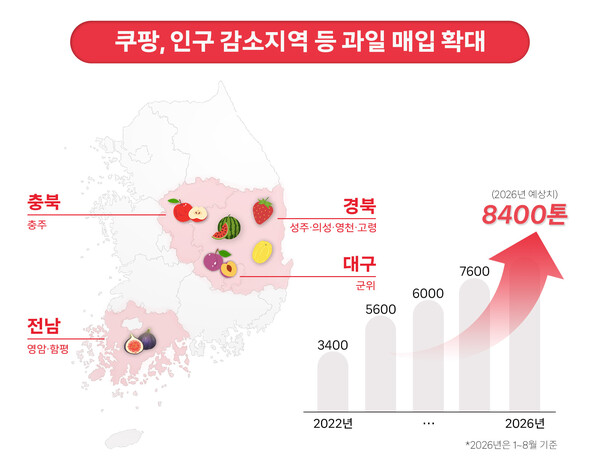
Coupang buys 7,000 tonnes of fruit from regional farms, including depopulating areas, in January to August this year, a record high for the period.
Coupang said on Sept. 21 that fruit purchased across eight areas including Yeongam and Hampyeong in South Jeolla Province, Seongju, Uiseong, Yeongcheon and Goryeong in North Gyeongsang Province, and Gunwi in Daegu, rose 10 percent from a year earlier to 7,000 tonnes.
Purchases through August this year are close to last year’s annual total of about 7,600 tonnes. Coupang’s purchases of regional fruit rose to 3,400 tonnes in 2022, 5,600 tonnes in 2023, 6,000 tonnes in 2024 and about 7,600 tonnes last year. The company expects this year’s annual total to exceed 8,400 tonnes.
Fruit Coupang buys from these areas includes about 30 types such as apples, Korean melons, plums, watermelons, strawberries and figs.
This year, the increase was large in places including Gunwi in Daegu, Goryeong in North Gyeongsang Province and Hampyeong in South Jeolla Province. Purchases of Goryeong watermelons rose 60 percent from a year earlier, Hampyeong figs 138 percent and Gunwi plums 73 percent.
Coupang explained that rising fruit demand led to higher purchases as it expanded its dawn-delivery logistics network into Honam, Yeongnam and Gangwon.
Sales by regional farms on Coupang also grew. According to the Gunwi Nonghyup Plum Joint Shipping Association, sales on Coupang by about 130 member farms total 1.6 billion won so far this year, double from a year earlier.
The Gunwi-gun Cooperative Joint Business Corporation is also selling branded “Gunwi plums” on Coupang for the first time since it was established.
According to the Korea Rural Economic Institute, South Korea’s farm population last year was 1,982,000, down 1.1 percent from a year earlier, and the share aged 65 or older was 56 percent.
A Coupang official said it will expand purchases from regional farms and cooperation for shared growth so farms in depopulating areas that struggle to find sales channels can keep growing.
 Lee Ho-jung
lhj@d-today.co.kr
Lee Ho-jung
lhj@d-today.co.kr