
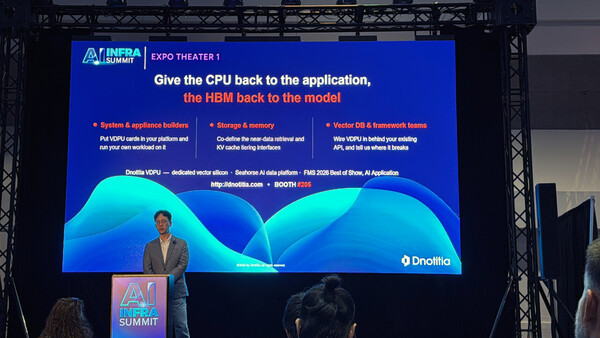
Dinotesia said on Sept. 18 it unveiled at the AI Infrastructure Summit 2026 in Santa Clara a server configuration equipped with four processor cards dedicated to vector search.
The processor card it unveiled is an architecture that extends the VDPU (Vector Data Processing Unit) to a server environment. Yang Se-hyun (양세현), chief technology officer at Dinotesia, introduced the VDPU architecture and performance evaluation results. "As agentic AI spreads, the importance of not only model computation but also data search performance is growing," he said. "VDPU is designed to handle vector search while allowing CPUs and GPUs to focus on their respective roles," he said.
In an FPGA-based evaluation, a server equipped with four VDPU cards showed vector-search throughput of up to 5.77 times compared with a dual-socket CPU-only server running the same software stack.
In a 4,096-dimension multimodal workload, the burden of building an index also fell. Host CPU usage fell 92 percent and memory use fell 73 percent. It raised throughput without degrading search quality, and search recall was equal to or higher than in the CPU-only environment. The performance targeted by the ASIC-based VDPU is vector search of up to 10 times that of CPU servers.
With this expansion, the application range of the VDPU chip and accelerator card was broadened to real servers. GPUs handle model execution and answer generation, while VDPU handles retrieval-augmented generation, or RAG, that finds external information to use in answers, as well as vector search for AI agents.
Dinotesia plans to begin ASIC-based evaluation from the fourth quarter of this year. In South Korea, it is pursuing commercialization by combining Seahorse and VDPU as AI data infrastructure that supports AI storage, search and use of enterprise data. In global markets, the company said, VDPU evaluations and proofs of concept, or PoCs, are expanding for server, storage, memory and semiconductor companies.
Yang said, "As we have showcased a VDPU server configuration at this event, we will expand evaluations and adoption going forward based on actual customer workloads."
 Daegeon Seok
d2dg@d-today.co.kr
Daegeon Seok
d2dg@d-today.co.kr