
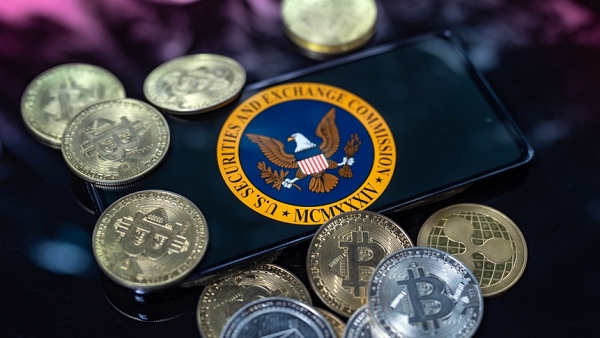
[DigitalToday reporter Jinju Hong] The U.S. Securities and Exchange Commission (SEC) approved a rule change by Nasdaq Texas and specified Solana (SOL) and XRP as “digital commodities” under exchange rules, following Bitcoin (BTC) and Ether (ETH). As the scope for managing cryptocurrency-related investment products also expands, expectations are rising that altcoins could gain a broader foothold in U.S. institutional markets.
On Sept. 4 (local time), blockchain media outlet U.Today reported that the SEC approved revisions to rules on Commodity-Based Trust Shares sought by Nasdaq Texas. The SEC order number is 34-106268.
The key change is the introduction of a new definition of “digital commodities” in Nasdaq Texas Rule 5711(d). The rules were also changed to allow actively managed cryptocurrency strategies and to permit assets that do not meet existing listing standards to be included up to 15 percent of a fund’s net asset value (NAV).
In the order, the SEC cited trusts including bitcoin, ether, solana and XRP as specific examples. By specifying the four assets as “digital commodities” that currently meet relevant eligibility requirements, the move is seen as laying the groundwork for XRP and solana to be treated alongside bitcoin and ether in the asset mix of cryptocurrency investment products.
The measure does not, however, mean a new federal-level commodities law classification for XRP or solana. The SEC approval relates to changes to Nasdaq Texas exchange rules and does not enact new laws that apply across the United States. It also does not directly approve the launch of a specific XRP ETF or Solana ETF.
Markets are focusing on the possibility that the rule change could influence the design of future cryptocurrency ETFs and trust products. Previously, the barrier to entry between assets that meet listing requirements and those that do not was relatively clear, but the ability to include separate assets up to 15 percent could make product design more flexible for asset managers.
Market sentiment also turned bullish. Over the past 24 hours, about 105,019 positions were forcibly liquidated in the cryptocurrency market, totaling $566.9 million. Liquidations of short positions accounted for most of the total at $478.91 million, triggering a strong short squeeze.
Total cryptocurrency market capitalization rose to around $2.711 trillion. U.S. spot bitcoin ETFs recorded inflows of $730.87 million in a day, with BlackRock’s IBIT accounting for the largest share at $454.0 million. Spot ether ETFs also saw $141.24 million of inflows.
Funds also continued to flow toward XRP. Spot XRP ETFs posted net inflows for 11 consecutive trading days, with cumulative inflows rising to $1.68 billion, according to compiled figures. Supply of RLUSD, an XRP Ledger-based stablecoin, also exceeded $1.0 billion, adding to expectations of greater institutional funding and broader use around the XRP ecosystem.
The macroeconomic environment also supported the recent rise in the cryptocurrency market. Federal Reserve Governor Christopher Waller referenced signs of easing inflation and said he supports holding rates steady at the Federal Open Market Committee (FOMC) meeting on Sept. 15 to 16. The market is taking it as a factor that can spur risk-asset appetite.
In the altcoin market, gains in privacy coin Zcash (ZEC) stood out. ZEC rose about 20 percent over 24 hours and at one point hit $1,023. Its rise over the past 30 days was 94 percent, and its one-year gain topped 2,300 percent.
Concerns about the use of public data by artificial intelligence (AI) agents and the traceability of transactions were cited as drivers behind Zcash’s surge. After the launch of OpenAI’s GPT-6 Astra, a large-scale unauthorized editing incident on the German programming site “DseWiki” became known, and analysis suggests that interest has again risen in assets that ensure transaction privacy on public blockchains.
Future U.S. legislative moves on cryptocurrency regulation are also seen as a key market variable. Attention is focused on a cloture vote in the U.S. Senate on the CLARITY bill scheduled for the 15th. If it passes, it could help make the regulatory framework for digital assets clearer, raising the possibility of further expectations for institutional entry for major altcoins including XRP and solana.
By contrast, it is difficult to say that U.S. cryptocurrency regulation has been fully put in order based solely on this SEC rule change for Nasdaq Texas. Separate requirements and procedures remain for the launch of investment products and whether each asset will be listed.
Brad Garlinghouse (브래드 갈링하우스), chief executive officer of Ripple, recently stressed that making the United States the world’s crypto capital is within reach and that regulatory work needs to be finished. If regulatory clarification in the United States continues, attention is focused on whether the institutional cryptocurrency market, which has been concentrated on bitcoin and ether, could expand to major altcoins such as XRP and solana.
 Jinju Hong
hongjj@d-today.co.kr
Jinju Hong
hongjj@d-today.co.kr