
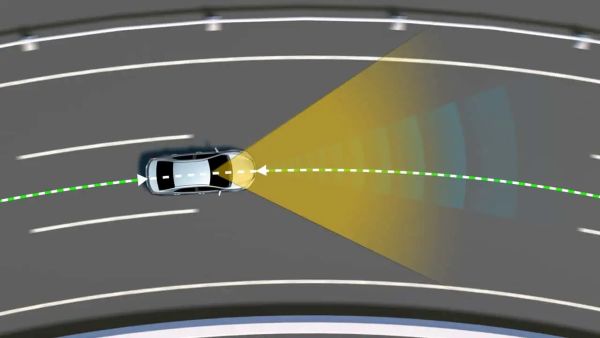
[Digital Today, intern reporter Seung-a Yoo] Toyota will introduce a next-generation advanced driver assistance system from 2028 model-year vehicles with supervised driving assistance functions similar to Tesla’s Full Self-Driving (FSD). Toyota plans to expand it to more models by 2030.
On Sept. 1 (local time), EV-focused outlet InsideEVs reported Toyota is developing next-generation ADAS that supports a wider range of driving situations than its current adaptive cruise control, lane centering, lane change assist and automated parking.
Japan’s Nikkei newspaper reported the system is expected to have functions at a “Level2++” level. Level2++ is not an official autonomy stage but an industry term used to describe capabilities between Level 2 and Level 3. Under Society of Automotive Engineers (SAE) standards, Level 2 supports functions such as adaptive cruise control and lane centering while the driver remains in control. At Level 3, the driver can take eyes and hands off while the system drives, but must be ready to resume control when requested.
Systems referred to as Level2+ or Level2++ fall in this middle area. They can support supervised driving to a destination in cities as well as on highways, in a way similar to Tesla’s FSD. The driver ultimately controls the vehicle and must intervene immediately if needed. It is not yet clear how far Toyota’s system will go within this range.
Toyota’s approach differs from Tesla’s. While Tesla puts weight on end-to-end AI in which a single neural network handles various driving situations, Toyota plans to also apply a “guardrail” system that monitors AI operation and blocks unexpected decisions. Guardrails monitor the AI’s judgments based on criteria set in advance by humans.
Toyota said it believes this approach can improve safety and claimed it could prevent about 60 percent of current traffic deaths and injuries.
Akihiro Sarada (아키히로 사라다), a manager at Toyota’s Software Development Center, said, “From a technical perspective, we will develop Level 4 technology, but provide commercial products at Level2++.” He added, “Based on the technology, we will push in a direction that secures both safety and explainability.”
That means even if the underlying technology is developed at a Level 4 standard, vehicles that are actually sold will offer a Level2++ approach in which the driver is responsible for driving.
Toyota plans to apply the system to 2028 model-year vehicles and then expand it to more vehicles by 2030. It is not yet known which country it will apply it to first.
Japan has already legalized Level 4 autonomous driving systems. Japan aims to have about 10,000 Level 4 vehicles, including taxis and buses, operating on roads by 2030. Level 4 is a stage in which the system performs all driving within conditions such as a defined operating area, and driver intervention is not required.
Toyota is also known to be discussing cooperation with Waymo to enter the robotaxi business. Specific details and timelines have not yet been disclosed.
 Seung-a Yoo
ysah@d-today.co.kr
Seung-a Yoo
ysah@d-today.co.kr