
[DigitalToday reporter Daegeon Seok] The government has opened up a 100 trillion won market by upgrading battery recycling from "waste treatment" to "critical mineral manufacturing". The Ministry of Trade, Industry and Energy plans to support companies' vertical integration by creating a special classification for the critical mineral resource-circulation industry and easing rules on moving into industrial complexes. The move opens a new market for Korean battery companies such as POSCO, EcoPro and SK On that have been working to build a circular ecosystem combining cathode production and recycling.
The battery recycling industry has been redefined from "waste treatment" to "critical mineral manufacturing". Last week, the ministry created a special classification for the critical mineral resource-circulation industry and moved to reach a 20 percent recycling rate for strategic minerals by 2030. The measures are expected to speed up vertical integration by Korean battery recycling companies that had been constrained by the Waste Management Act, combining cathode production and recycling.
Battery recycling refers to a set of recycling businesses that extract critical minerals such as lithium, nickel and cobalt from electric vehicle batteries. It is also called an "urban mine" that replaces mineral mining. With global environmental regulations such as the U.S. Inflation Reduction Act and Europe's Critical Raw Materials Act making the use of recycled raw materials mandatory, the market is expected to grow to 100 trillion won by 2030.
According to the ministry, establishing the special classification is meant to solve a problem in which the resource-circulation industry was split across manufacturing and waste treatment under the standard industrial classification, making systematic support difficult. The new classification system consists of 4 major categories, 10 mid-level categories and 32 subcategories. It covers the full process from raw material collection to intermediate materials and final material manufacturing. The government plans to prioritise companies under the special classification for a new "critical mineral resource-circulation facilities and equipment support programme" to be launched in 2026 and to ease rules on moving into industrial complexes.
Yoon Chang-hyun, director general for resource industry policy at the ministry, said the special classification is a first step toward having the resource-circulation industry recognised as a critical mineral manufacturing industry. He said the government plans to build an ecosystem for the resource-circulation industry and realise domestic supply chains for critical minerals.
Battery recycling recognised as manufacturing: "Not trash disposal but mineral production"
Easing regulations has become the final piece of the circular ecosystem strategy companies have pursued, known as the "closed loop" strategy. Closed loop is a vertical integration model that builds the full process from battery manufacturing to recycling into a single circular system. In the past, recycling facilities were classified as undesirable facilities, limiting entry into cathode production complexes. The measures now allow more efficient operations by placing materials production plants and recycling facilities in one location.
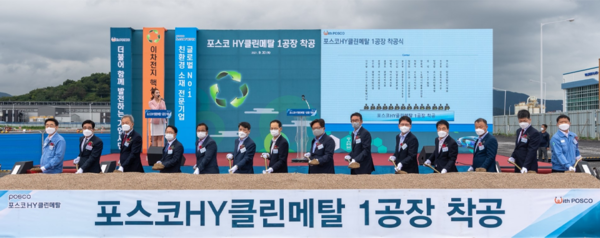
POSCO Group has already implemented this model at the Yulchon industrial complex in Gwangyang, South Jeolla Province. POSCO HY Clean Metal directly supplies lithium and nickel extracted from used batteries to the adjacent cathode plant of POSCO Future M. POSCO HY Clean Metal's battery recycling plant, completed in July 2023, can process more than 1,000 tons of metals per quarter. The government's easing of industrial park entry rules is expected to spread such integrated production models further.
Tangible results are also emerging. According to POSCO Holdings, POSCO HY Clean Metal's utilisation rate surged to 95 percent in 2023 from 26 percent in 2022 and has remained around 97 percent since 2025. Revenue rose nearly fourfold to 83 billion won in 2023 from 21 billion won in 2022.
It also sharply reduced its initial operating losses to 7 to 12 billion won per quarter in 2024 from 107 billion won in 2022. POSCO Future M produces eco-friendly cathode materials using recycled valuable metals. It is also developing secondary recycling technology to extract natural graphite from waste sludge.
EcoPro has built a complete value chain at its Pohang campus, linking lithium, precursors, cathodes and recycling. EcoPro CNG extracts valuable metals from battery scrap, EcoPro Materials processes them into precursors and EcoPro BM makes cathode materials. In September last year, EcoPro Innovation and EcoPro CNG merged, elevating recycling to a core business.
EcoPro CNG, which leads the business, signed a mid- to long-term supply contract for black mass with Japan's Metaldo in October last year. Founded in 1962, Metaldo is a specialised company that produces black mass by receiving used batteries from Japanese battery companies including Panasonic. Park Suk-hwoi, CEO of EcoPro CNG, said the first mid- to long-term deal with Japan would help secure black mass.
Prepared POSCO, EcoPro and SK On accelerate building a circular ecosystem
A path has also opened for companies struggling in a battery chasm phase. SK On signed a supply deal in August last year with EcoPro for black powder using scrap from its U.S. production unit. Under the structure, EcoPro reprocesses about 200 tons a month of black powder from SK Battery America into cathode materials and supplies them back to SK On. The contract term is 5 years, through 2029.
SK On aims to extract core materials from used batteries and scrap and reinsert them into its battery production, completing a virtuous cycle structure of production, discharge, collection and reproduction. At the time, Lee Kyung-min, head of business development at SK On, said whether companies build a recycling business model for a circular ecosystem is emerging as a key competitiveness factor within the battery value chain. He said the company will strengthen battery supply chain self-reliance and build a structure that can respond flexibly to rapidly changing market conditions.
Beyond that, battery companies are also looking to build a Korean-style recycling cluster. According to the ministry, there are about 200 domestic resource-circulation companies, and most are small except for some large conglomerates and are focused on certain items such as used batteries and used catalysts.
But the establishment of the special classification and the easing of regulations are expected to accelerate the creation of a Korean-style recycling cluster that combines small companies' technology and large companies' capital. An industry official said the recycling industry, which has faced many constraints in attracting investment or expanding business, now seems likely to be recognised as manufacturing. The official said a new market has opened due to the trend of strengthened global environmental regulations and supply chain restructuring.
 Daegeon Seok
d2dg@d-today.co.kr
Daegeon Seok
d2dg@d-today.co.kr