
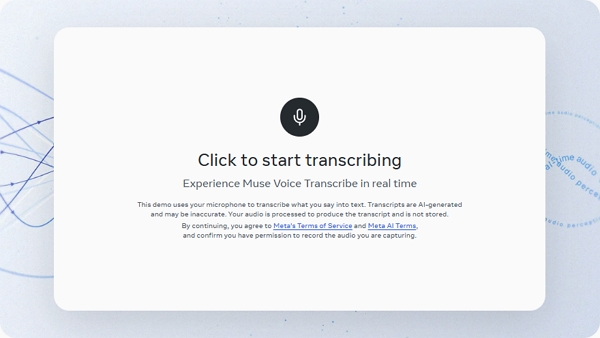
Meta unveiled Muse Voice Transcribe on Sept. 1, local time, an AI model that transcribes speech in real time while distinguishing speakers. It can handle conversations involving more than 20 people and recognise multilingual and mixed-language dialogue, including Korean.
Transcribe is the first real-time audio recognition model developed by Meta Superintelligence Labs (MSL). It is an autoregressive model in the Muse Spark family of multimodal reasoning models. It handles real-time automatic speech recognition, speaker separation and end-of-utterance detection in a single model.
It processes audio in 80-millisecond units. It applies adaptive latency technology that lets the model decide whether to listen to more audio or immediately convert it to text depending on word difficulty, balancing accuracy and response speed. Meta said it ranked first as of that day in Artificial Analysis' streaming speech recognition evaluation, posting a final transcription word error rate of 3.1 percent.
It also emphasised price competitiveness. Meta Model API fees are $0.18 per hour of audio, or $3 per 1,000 minutes. That is among the lowest levels among major real-time speech recognition models compared by Artificial Analysis.
The model was trained in more than 70 languages. Of these, 25 languages, including Korean, English, Japanese, Chinese and Spanish, underwent extensive verification. It also natively supports code switching, such as mixing multiple languages within a sentence or changing languages from sentence to sentence. It also has a function that improves recognition accuracy by providing specific language and keyword and context information in advance.
It can handle audio longer than 1 hour and conversations involving more than 20 speakers without separate post-processing. As a result, it is expected to be highly usable in environments with multiple speakers, such as meeting minutes, interviews, lectures and call centres.
Muse Voice Transcribe is currently available on the Meta Model API, Meta AI for Mac and the AI coding tool Muse Code. On Macs, users can use the voice input function in other applications by speaking while holding down the Fn key.
 Choi Jae-won
ittt_0801@d-today.co.kr
Choi Jae-won
ittt_0801@d-today.co.kr