
A survey finding that South Korea’s ultra-fast internet speed has slipped to 22nd in the world drew criticism in parliament that the country’s three telecom carriers are not investing enough in fibre-optic networks. The government agreed on the need for more investment but raised questions about the reliability of the findings by an overseas private company.
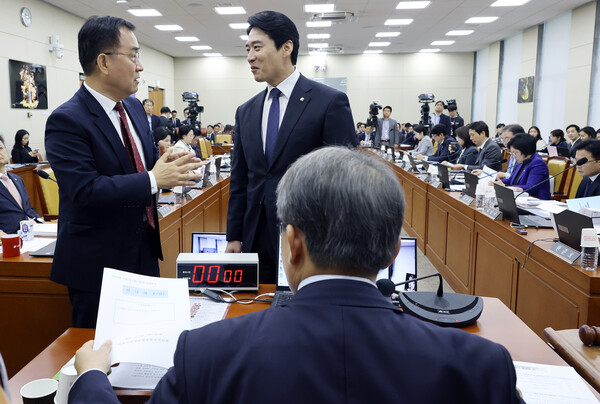
At an audit by the National Assembly’s Science, ICT, Broadcasting and Communications Committee on Oct. 15, Democratic Party lawmaker Lee Yeon-hee (이연희) pointed to insufficient domestic telecom network investment based on survey results by global internet speed measurement company Ookla.
Ookla said South Korea’s fixed ultra-fast internet download speed in August was 251.33 Mbps, ranking 22nd in the world. Vietnam ranked 8th at 301.48 Mbps and Thailand ranked 9th at 298.92 Mbps. In city rankings, Seoul was 34th.
Lee called for a full investigation into the aging state of domestic fixed-line telecom networks and improvements to the system for evaluating telecom service quality. “The three telecom carriers are fixated only on profitability and are neglecting investment in fibre-optic communications infrastructure,” she said. She criticised it as “a phenomenon that occurred because they are not investing in fixed-line fibre-optic networks.”
Choi Woo-hyuk (최우혁), director general for information security and network policy at the Ministry of Science and ICT, said, “I agree that telecommunications is the most important AI-based infrastructure.” “We will encourage telecom operators to actively invest in infrastructure,” he said. The ministry has formed a public-private consultative body after a meeting in July between Deputy Prime Minister Bae Kyung-hoon and the chief executives of the three telecom carriers to discuss expanding investment and government support measures.
Choi also pointed to a lack of objectivity in Ookla’s survey. “It is a rather difficult situation because it is providing only the speed without presenting standards on what service was measured and how it was measured,” he said. He said he would report the related details separately.
The ministry also issued explanatory material the previous day, countering that objective comparisons are difficult because Ookla does not disclose detailed conditions such as the number of measurements by country and the composition of subscription plans. In a government quality assessment last year, domestic fixed-line internet speeds were measured at 496.05 Mbps for 500 Mbps-class service and 987.70 Mbps for 1 Gbps-class service.
The Korea Telecom Operators Association, or KTOA, also said on the day that Ookla’s findings did not sufficiently reflect differences in subscribed plans and measurement environments, and said it would again request disclosure of detailed measurement data.
 Jin-ho Lee
jhlee26@d-today.co.kr
Jin-ho Lee
jhlee26@d-today.co.kr