
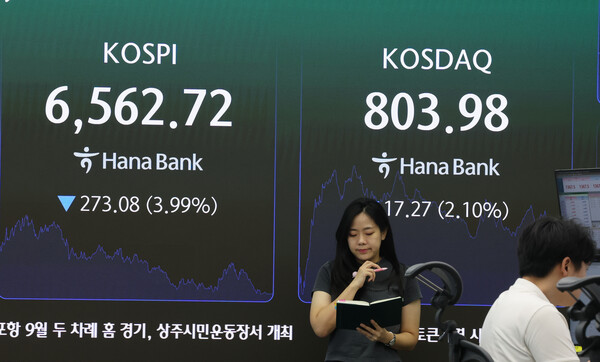
KOSDAQ, which rebounded in August with a record monthly gain, faces a policy test in September. With the introduction of a tiered system aimed at drawing institutional funds delayed, concerns that tighter delisting criteria could weaken growth companies are emerging as a factor for further gains.
On Sept. 2, KOSDAQ closed at 803.98, down 17.27 points, or 2.10 percent, from the previous session. KOSDAQ rose 15.91 percent in August, climbing from 719.76 on July 31 to 834.29 on Aug. 31, according to the Korea Exchange.
It was the highest August gain since the market opened in 1996. Average daily trading value was 5.9581 trillion won, just 38.3 percent of May's 15.57 trillion won and the lowest this year.
The market is watching whether government measures to revitalise KOSDAQ can fill the liquidity gap. In its "capital market structural improvement plan" announced in March, the government set out a direction to split KOSDAQ into tiered segments and develop an index and exchange-traded funds (ETFs) based on a group of high-quality companies.
At the time of the announcement, the tentative name suggested for the top segment was "Premium". Later discussions raised a plan to classify KOSDAQ-listed firms into "Select" for blue-chip and representative companies, "Standard" for general growth companies, and a "managed group" that includes firms at risk of delisting.
The idea is to regularly assess not only market capitalisation and performance but also qualitative competitiveness, promote or demote companies, and create a separate index and ETFs based on top-segment stocks to attract institutional investors.
If the system takes hold, more products could allow investors to buy KOSDAQ blue chips as a package, and the base of institutional flows could widen. It is also expected to reduce the image of KOSDAQ as a retail-driven, highly volatile market. For companies, it creates an incentive to improve performance and governance to enter or remain in the top segment.
But the assessment criteria and differences in flows by segment are contentious. The venture industry worries that if weight is placed on financial performance such as market capitalisation, revenue and operating profit, biotech and artificial intelligence (AI) companies with long research and development timelines could be put at a disadvantage.
Some also point out that if money concentrates in the top segment and ETFs that track it, share prices and fundraising conditions could worsen further for companies in the Standard and managed groups.
The schedule is also being pushed back due to such opposition. The exchange had planned to announce the overhaul direction at an event marking the 30th anniversary of the KOSDAQ market on July 1, but postponed it to gather industry views. A public hearing in August and a detailed plan announcement in September and October were later mentioned, but no public hearing had been held by the end of August.
The exchange is reportedly reviewing an option to explain the introduction plan at "KOSDAQ Day" on Oct. 6-7, but whether it will make an announcement and the detailed criteria have not been finalised.
Tighter delisting rules are another variable for KOSDAQ. From July 1, a rule took effect under which a stock is designated as an issue under management if its price stays below 1,000 won for 30 consecutive trading days or if its market capitalisation remains below 30 billion won for KOSPI and 20 billion won for KOSDAQ for 30 consecutive trading days. If, within 90 trading days after the designation, it fails to exceed the relevant threshold for 45 consecutive trading days, it is ultimately delisted.
As of Aug. 14, 39 stocks had disclosures designating them as issues under management due to penny-stock status or failure to meet market capitalisation requirements. From Aug. 10 to 15, 8 stocks were additionally disclosed as at risk of being designated as issues under management.
Under the rules, actual delisting cases could emerge as early as Oct. 21. From Jan. 1, 2027, the market capitalisation thresholds will also rise to 50 billion won for KOSPI and 30 billion won for KOSDAQ.
Companies are pursuing reverse stock splits and capital reductions to avoid delisting risks. According to the industry, 276 reverse stock splits were pursued in the domestic stock market between Feb. 12, when the delisting reform plan was announced, and Aug. 12, when the first managed-issue designation appeared.
Of those, 219 cases were on KOSDAQ. But reverse stock splits only change the number of shares and par value and do not raise market capitalisation or corporate value, making it difficult for them to be a fundamental solution.
Some have also argued that if expulsion is decided solely by share price or market capitalisation, even profitable companies could be targeted. Lee Eok-won (이억원), chairman of the Financial Services Commission, said at the National Assembly's Political Affairs Committee on Aug. 24, "We will review parts that need fine-tuning." He also said a sweeping change would be difficult given the need for policy credibility.
Ultimately, for KOSDAQ to rise further, assessment criteria need to be designed to draw institutional money into high-quality companies while preventing growth firms from being disadvantaged based only on short-term performance or share prices.
The argument is that safeguards are needed to distinguish the growth stage and financial conditions of research-and-development-focused companies, while maintaining the policy goal of swiftly removing weak companies.
A financial investment industry official said, "Unlike KOSPI, KOSDAQ needs to be approached from the perspective that it is not simply an investment target but a market that fosters future industries."
 Sangyeob Oh
yub@d-today.co.kr
Sangyeob Oh
yub@d-today.co.kr