
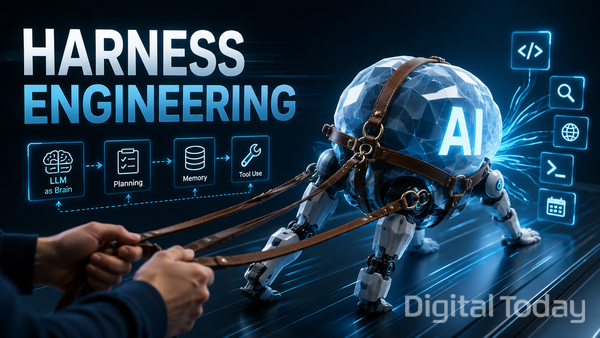
As AI evolves rapidly, new AI-related concepts and terms are increasing. Recently, the AI model harness has emerged as one of the keywords drawing attention. Harnesses are being treated as a major issue, especially in the enterprise AI market.
A harness, which refers to tack fitted on a horse or ox, is used in the AI field to mean a “work environment” that connects models, tools and execution processes so AI can perform tasks such as coding or search. It can be described as software that bundles and manages functions needed for AI agents to actually do work.
A recent Wall Street Journal report citing David Fan, AI industry practice lead at credit-rating company Moody's, said a “harness” surrounding a model is the code that actually runs an AI system. It provides context such as memory and enterprise data to an AI model and enables AI agents to carry out real tasks.
Fan said, "A harness is a system that wraps the 'brain' of an AI model. Through the harness, users can control an AI model and make it move in the direction they want. It is like putting a harness on a horse so the rider can lead and move the horse."
In the AI field, harnesses appear to be drawing more attention this year. The industry says their presence is growing as reasoning models evolve. Anthropic said combining a high-performing harness with a reasoning model allows an AI model to connect to real systems, execute code and manage workflows.
Rising interest in harnesses in the enterprise market is related to control over AI. Fan said a harness can be a way for companies to regain control over AI.
Through so-called harness engineering, in which companies develop the software that surrounds AI models themselves, they can build processes without being tied to an AI model. This means they can reduce the risk of relying too heavily on a specific AI provider.
They can avoid being locked into a specific AI model. As a result, dependence on a single AI supplier also falls.
A harness can be developed in-house or adopted from an external provider. Recently, companies have been rolling out products and technologies that use the term harness.
Large AI research and development companies such as OpenAI and Anthropic are also providing their own model harnesses for corporate customers. DeepSeek's recently open-sourced 'DeepSeek Harness' is also spreading quickly after receiving positive reviews in the developer community. DeepSeek Harness received more than 33,000 stars on GitHub within hours of its release, and the number is rising quickly. A community plugin ecosystem has already formed actively.
Enterprise software company Salesforce is also signaling a major push into the enterprise harness market with 'AIforce.'
Salesforce targets enterprise AI harnesses with 'AIforce'
Fan, cited by the WSJ, said companies in regulated sectors such as banks or governments should build their own harnesses to avoid exposing work processes to outsiders.
There are also many views that there is no need to build a harness yourself. The WSJ reported that biopharmaceutical heavyweight Bristol Myers Squibb chose Anthropic Claude as a 'standard harness' to avoid the work of rebuilding basic infrastructure tools.
Kartik Sarangmath (카르틱 사랑마스), a co-founder of integrated dashboard platform developer Omnara (omnara), which enables remote monitoring and control of various AI coding agents across mobile, web and desktop, also stressed recently on social media platform X (Twitter) that the focus should be less on whether to build or buy a harness and more on system prompts, provided tools and how to interact with systems. He said, "There is no need to build a harness yourself, and not every task needs a harness. It seems like it would save much more time to just use a good harness and move on."
According to the WSJ, the router, one of the key components of a harness, has also emerged as a strategic battleground in the AI field.
A router is software that automatically selects appropriate models for different tasks. As companies take more interest in cutting AI costs, interest in routers also appears to be growing. Recently, large payments platform company Stripe acquired OpenRouter, which specializes in routers, for more than $7 billion, and the number of companies jumping into the router arena continues to grow.
 Chi-gyu Hwang
delight@d-today.co.kr
Chi-gyu Hwang
delight@d-today.co.kr