
South Korea's Electronics and Telecommunications Research Institute (ETRI) said it would take on the challenge of developing a "director-level AI scientist" by 2035 that autonomously carries out the entire research process. It also plans to develop technologies spanning AI semiconductors, optical networks and computing software.
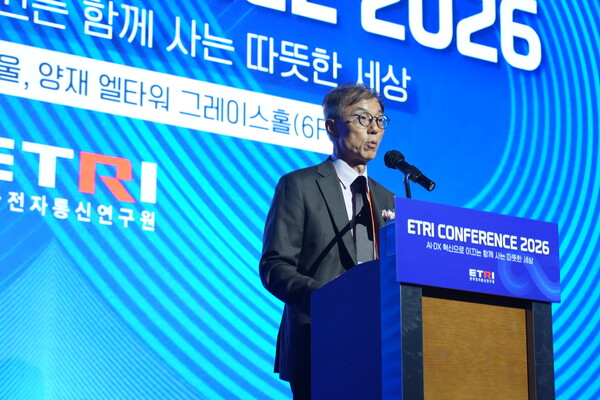
ETRI on Sept. 1 held the 'ETRI Conference 2026' at the EL Tower in Yangjae, Seoul, and unveiled its future vision and AI innovation strategy. About 600 people attended, including representatives from industry, academia and research institutes.
ETRI President Se-woong Park (박세웅) presented a new institutional vision: "A warm world where we live together, led by AI and DX innovation." The plan is to implement "technology for people," such as helping human labor and mobility and overcoming disabilities through AI and digital transformation (DX).
As an innovation strategy to support that, it put forward a "4E Combination." It aims to pursue R&D and management innovation together by combining Essential, Embracing, Exciting and Excellent.
ETRI said it would concentrate its R&D capabilities in five areas to secure an engine for national innovation-driven growth: AI-native 6G and satellite communications, safe artificial general intelligence (AGI), immersive space media, physical AI, and public and industrial AI and DX. It plans to streamline and consolidate non-strategic fields and strengthen mission-oriented flagship R&D and efforts to secure core technologies by sector.
◆Developing a 'director-level AI scientist' by 2035...autonomously carrying out the full research process
In particular, it aims to change the way science and technology R&D itself is conducted through a strategy dubbed "AI scientist for everyone." ETRI plans to develop by 2035 a "director-level AI scientist" that autonomously conducts the full research cycle from hypothesis formulation to experiments, analysis and verification.
In the initial stage, it will implement an "AI research colleague" in which researchers set hypotheses and conduct experiments with AI. It will then advance to an autonomous science system in which AI operates scientific agents and laboratories under researchers' supervision. Ultimately, it plans to build a full-cycle autonomous research system in which AI carries out multiple research projects in parallel.
To do this, it plans to secure key technologies including science-specialized foundation models and specialized AI agents, hypothesis generation and prioritization, experiment design, agent orchestration, a science AI operating system, and autonomous laboratories, and integrate them into a Korea-style AI scientist platform.
◆NAIS-state-funded research institutes 'hub+spoke'...turning AIDC into a 'token factory'
It also outlined plans to build an AI scientist ecosystem linked with the National Science and Technology Research Council's National Science AI Research Center (NAIS). Under a "strong hub + strong spoke" model, NAIS will serve as a hub providing shared foundations such as data standards, common foundation models and a GPU pool, while government-funded research institutes such as ETRI conduct specialized research by field.
ETRI also unveiled its AIDC technology strategy to respond to infrastructure competition in the AI era. It defined AIDC as a "token factory" that inputs electricity and data to produce AI compute power and tokens, and said it had determined that the center of AI competition is shifting from individual semiconductors to entire data center infrastructure.
ETRI said that by 2031 it would secure in stages technologies including 12.8 Tbps-class optical input/output chiplets, 3.2 Tbps-class optical transceivers and key optical components. It aims to then expand from a single-node data center to wide-area distributed AIDC, and after 2032 develop into a collaborative AIDC that links computing resources on the ground and in space.
Park said, "Over the past 50 years, ETRI has created technologies needed by the nation and the public at every important moment when South Korea took a leap forward as an ICT powerhouse." He added, "We will open up and cooperate beyond the boundaries of research institutes, universities and companies, while leading national missions including the AI scientist and AIDC, and create the core technologies needed for South Korea to leap forward as one of the top three AI powers."
 Jin-ho Lee
jhlee26@d-today.co.kr
Jin-ho Lee
jhlee26@d-today.co.kr