
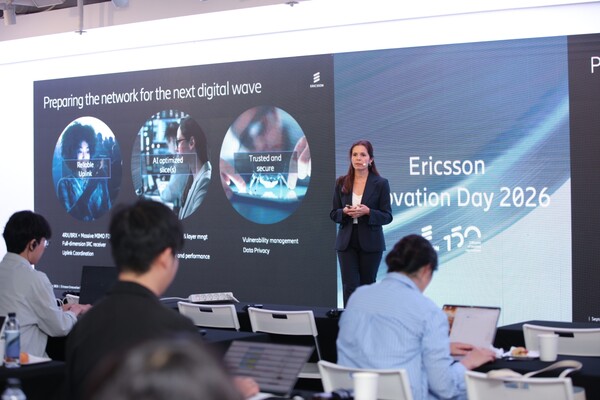
Ericsson presented 5G standalone (SA) and 5G Advanced as core foundations for AI-era networks and for the transition to 6G. With the spread of physical AI making uplink more important, it sees communications networks evolving into intelligent infrastructure that guarantees performance.
Ericsson Korea held an 'Ericsson Innovation Day 2026 Korea' media briefing in Seoul on Sept. 1 and unveiled directions for network evolution in the AI era, AI-based radio access networks (AI-RAN) and its integrated sensing and communication (ISAC) strategy.
Sibel Tombaz (시벨 톰바즈), head of Ericsson Korea, said mobile communications over the past decades focused on connecting devices, while the next 10 years will shift toward connecting intelligence. She said the accelerating move to physical AI has made networks more important in supporting connections among AI, AI agents and devices. 다.
It also said AI will change network traffic trends. While existing mobile networks developed around downlink performance, the influence of AI glasses, robots and autonomous driving will make uplink performance important as large volumes of data are sent to networks.
Tombaz said uplink traffic is expected to increase 3 to 5 times by 2030 from current levels. She said uplink can no longer be treated as secondary in network design.
Network performance needs also vary by AI service, it said. Physical AI and robots require short, predictable latency and high reliability. Ericsson said 'differentiated connectivity' is needed to guarantee a certain level of performance by service, using tools such as network slicing.
It forecast telecom operators' revenue models will shift from data usage to service outcomes and quality. Tombaz said consumers will pay not simply for data, but to get the results they want. She said global telecom operators are also generating additional revenue using differentiated connectivity and are evolving related charging models.
It said 5G SA is a key technology to enable this. Based on 5G SA, applying network slicing and quality assurance technologies makes it possible to differentiate latency, uplink speed and stability by AI service.
Matteo Fiorani (마테오 피오라니), head of Ericsson's network portfolio, said a shift to 5G SA is needed to provide dedicated connectivity to AI model or service providers and monetise it. He said it is difficult to sufficiently support such functions in 5G non-standalone (NSA) or existing networks.
Ericsson defined AI-RAN not as a concept limited to a specific product or AI accelerator, but as an architecture that applies AI across radio access networks. It said it aims to use AI to boost network performance, energy efficiency and operational efficiency while also providing the connection quality demanded by AI applications.
Fiorani said robotics has particularly demanding latency requirements among AI applications. He said it is important to efficiently place the necessary intelligence across the network, edge data centres and radio sites.
Ericsson also pointed to hardware capabilities such as its own silicon, AI-enabled radios and massive multiple-input, multiple-output (Massive MIMO). It said as AI inference is carried out across networks, the importance grows of silicon supporting microsecond-level processing and network optimisation technologies.
ISAC, which uses communications networks like sensors, is also expected to be a key technology for next-generation networks. ISAC uses network radio waves to detect movements of people or objects not directly connected to the network. It can be used across fields including transport, industrial sites, key infrastructure and drones.
Fiorani said ISAC could be a game changer because it can detect objects that are not connected. On personal data protection, he said discussions are under way applying strict personal information policies at a level similar to communications security.
Ericsson said it sees this network evolution progressing step by step through 5G SA and 5G Advanced, rather than happening suddenly in 6G.
Tombaz said it will support Korean partners in realising new business opportunities based on differentiated connectivity and technology leadership that leads to 6G.
 Jin-ho Lee
jhlee26@d-today.co.kr
Jin-ho Lee
jhlee26@d-today.co.kr