
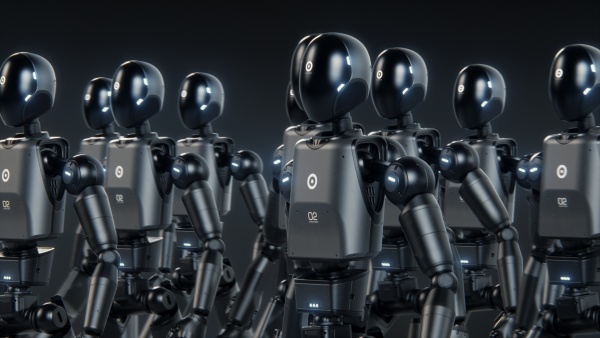
[Digital Today reporter Jinju Hong] Chinese automakers are selecting humanoid robots as a next-generation revenue business and stepping up investment. As profitability in the electric vehicle market declines, they are moving to apply manufacturing capabilities and supply chains built through car production to robotics.
TechCrunch reported on Aug. 28 local time that Xpeng's robotics unit recently raised more than $900 million at a valuation of more than $6.3 billion.
The investors included IDG Capital, Gaorong Ventures, Tencent and Alibaba. Xpeng described the fundraising as the largest private investment in a single round in China's embodied AI industry. Embodied AI refers to technology that installs AI directly into physical machines so they can move and work in the real world.
Chinese automakers' push into robotics does not stop with Xpeng. Chery Automobile's robotics unit, Aimoga, is reported to have begun preparations this month for an initial public offering. BYD unveiled its humanoid robot "Xiao Di", and Changan Automobile, Guangzhou Automobile Group, Li Auto, SAIC Motor, Seres and others are also developing humanoid robots.
In the industry, Xpeng is seen as the Chinese automaker that most actively follows Tesla's strategy. Michael Dunne (마이클 던), chief executive of Dunne Insights, assessed that Xpeng is most focused on autonomy and was the first to begin large-scale investment in humanoid robots.
He described Xpeng founder He Xiaopeng (허샤오펑) as a tech billionaire known for fast decision-making and coordination. He said that as profit margins in the auto business fall sharply, robotics could become a more promising revenue source.
Xpeng executives also invested directly. He Xiaopeng and co-president Brian Gu (브라이언 구) were reported to have invested about $100 million in the latest fundraising round.
The robot Xpeng is developing as a core product is the humanoid robot "Iron", aimed at commercial deployment. Its strategy is to use hardware development and mass-production experience accumulated in the car manufacturing process to commercialise robots.
The biggest reason Chinese automakers are drawing attention in the humanoid robot market is manufacturing competitiveness. Michael Dunne said Chinese automakers have the capabilities needed to develop robot hardware. He said foundations built in the auto industry, including parts production, supply chains and mass-production experience, can also be used to manufacture robots.
But the key competitiveness ultimately is AI. Dunne said Chinese companies have strengths in hardware, but the key is whether they can catch up with Tesla in AI, which governs robots' movement and judgment.
That means that for Chinese automakers to lead the robot market, they must go beyond simply mass-producing robots and secure software and AI technology that can understand human behaviour and perform various tasks.
Humanoid robot competition is expanding beyond China to the broader global auto industry. Robot companies such as Agility Robotics, Apptronik and Figure are also competing with a goal of large-scale commercial deployment. In the auto industry, both automakers and parts and technology companies are entering robotics businesses.
Boston Dynamics, owned by Hyundai Motor, is a representative case. Hyundai plans to deploy Atlas humanoid robots at its Georgia plant this year and use them for tasks such as parts arrangement through 2028.
Boston Dynamics is cooperating with Google's AI research organisation DeepMind to speed up Atlas development. It also plans to open a dedicated facility in the United States within this year to support training for robot motions such as lifting and rotation.
Other car companies are also expanding robot investment. Mobileye acquired humanoid robot startup Mentee Robotics for $900 million early this year. Rivian also entered robotics through the spinoff of Mind Robotics, although the robot it is developing is expected to take a different form from a typical humanoid.
Ultimately, the auto industry's push into robotics is tied to an industrial environment in which it is becoming difficult to secure high profitability from electric vehicles and car manufacturing alone.
Chinese automakers are rapidly entering the humanoid robot market by leveraging existing manufacturing and supply-chain competitiveness. Going forward, competition is expected to hinge not just on how many robots can be produced cheaply, but on how accurately they can be made to understand and carry out human work.
As factories that made cars change into factories that make robots, the auto industry's next revenue-source contest is shifting from electric vehicles to humanoid robots.
 Jinju Hong
hongjj@d-today.co.kr
Jinju Hong
hongjj@d-today.co.kr