
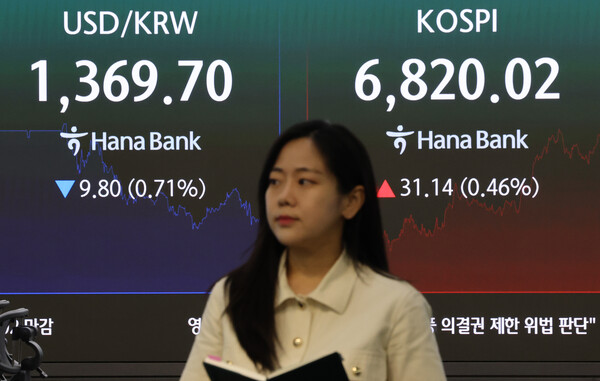
The KOSPI, which saw a record plunge and sharp rebound in July, moved sideways in August amid relatively lower volatility. In September, the market is expected to take its cue from whether U.S. long-term yields stabilise, foreign funds return and gains spread beyond semiconductors.
On Aug. 31, the KOSPI ended up 31.14 points, or 0.46 percent, at 6,820.02. It rose as high as 7,010.86 intraday on Aug. 14 before retreating to 6,977.94, and on Aug. 18 it climbed to 7,216.62 before closing at 6,869.83. The index cleared 7,000 twice during the month, but lacked the momentum to sustain the rise.
The biggest change in August was not the rise in the index but a drop in volatility. The KOSPI 200 volatility index (VKOSPI) fell 40.6 percent to 50.08 on Aug. 28 from 84.35 on July 31.
Some of the deleveraging and the concentration in semiconductors that rattled the market in July also eased. Still, the volatility index remains above its long-term average, prompting assessments that it is too early to say the market has fully normalised.
Earnings forecasts are a factor favourable to the September market. The Korea Exchange said the 2026 operating profit forecast for KOSPI-listed companies stood at 989.7 trillion won as of Aug. 27, up 1.5 percent from 974.9 trillion won at the end of July.
The 2027 forecast was also raised to 1,314.3 trillion won from 1,310.9 trillion won over the same period. The KOSPI's 12-month forward price-to-earnings ratio is low at around 5.5, and some analyses say that if earnings forecasts hold, it is difficult to view 7,000 as an overvalued zone.
Roh Dong-gil (노동길), a researcher at Shinhan Investment Corp, presented an expected September range for the KOSPI of 6,600 to 8,000. Applying a 12-month forward earnings per share of 1,205.9 and a fair PER of 8.5 that reflects interest rate levels puts the KOSPI's theoretical fair level at 10,250, he said.
Expanding shareholder returns is also cited as a factor that could support the index's downside. According to the industry, cash dividends and share buybacks by KOSPI-listed companies rose to around 70 trillion won in 2025 from around 59 trillion won in 2024.
In 2026, the total expanded to around 77 trillion won, including large buyback plans announced through August. If buybacks absorb foreign selling, they can reduce supply-demand volatility in large semiconductor shares.
A recovery in foreign flows is needed to break above and settle at 7,000. South Korea's market is sensitive to moves in Samsung Electronics and SK Hynix, which have large market-cap weightings. Even if semiconductor profit forecasts hold, the index's upside may be capped if foreign funds leave on rising U.S. rates.
Conversely, if foreign net buying resumes amid solid memory prices and exports, the combination with buybacks increases the likelihood that the index stays above 7,000.
U.S. long-term yields are the biggest external variable. The 10-year U.S. Treasury yield rose to around 4.72 percent as of Aug. 28, nearing 5 percent. Higher long-term yields reduce the present value of future profits, weighing on valuations of growth stocks such as semiconductors and biotech. If the U.S. economy and inflation come in stronger than expected and yields approach 5 percent, downside pressure on the KOSPI could increase.
In September, a run of events that will shape the direction of rates will continue. The ISM manufacturing purchasing managers index and the Job Openings and Labor Turnover Survey are released on Sept. 1, the jobs report on Sept. 4, and the consumer price index (CPI) on Sept. 11.
The Federal Reserve holds its Federal Open Market Committee meeting on Sept. 15 to 16 and releases economic projections. A Micron earnings announcement scheduled for Sept. 30 is also expected to serve as an occasion to reaffirm profit forecasts for South Korea's semiconductor sector.
Sector strategy is converging on keeping semiconductors at the core while preparing for rotation. Kim Jong-min (김종민), a researcher at Samsung Securities, presented three pillars: artificial intelligence (AI) leaders, shares expected to benefit from year-end shareholder returns and sectors in which only domestic companies have competitiveness. Lee Kyung-min (이경민), a researcher at Daishin Securities, pointed to healthcare, securities, banks and retail and distribution as rebound candidates among oversold sectors with improving earnings forecasts.
In late August, buying also spread to other shares while semiconductors weakened. Comparing closing prices on Aug. 21 and Aug. 28, 712 of 942 KOSPI-listed stocks rose.
Even as Samsung Electronics and SK Hynix fell over the same period, broader gains suggest the index market and the stock market are starting to diverge. In September, semiconductors could open the index's upside while non-semiconductor sectors offset returns.
Lee Jae-man (이재만), a researcher at Hana Securities, said, "The adjustment in the domestic stock market is over, but the rebound is falling short of expectations." He added, "Index rebounds seen in situations such as the global financial crisis or the COVID-19 pandemic were possible through coordinated policy rate cuts by central banks, but now, given the economy and corporate earnings expansion, the possibility of policy rate hikes remains."
 Oh Sang-yup
yub@d-today.co.kr
Oh Sang-yup
yub@d-today.co.kr