
Elon Musk (일론 머스크), CEO of SpaceX, unveiled a plan to directly cast key gas turbine components to reduce bottlenecks in power supply for artificial intelligence infrastructure.
On Aug. 30, tech outlet TechCrunch reported that a secret foundry in Bastrop, Texas is known as a facility to produce gas turbine blades and vanes.
Musk said on Aug. 30 on X, formerly Twitter, that SpaceX and Tesla are each building 100 gigawatts of annual solar production capacity as quickly as possible. He explained that natural gas will be needed for the next few years to complement solar power and support early scale-up. Musk said the bottleneck in natural gas turbine production is casting blades and vanes, and that if SpaceX casts them in-house it could bring forward turbine start-up by as much as 18 months.
The backdrop is a power shortage in the AI industry. As a shortage of graphics processing units persists, including Nvidia's latest Blackwell chips still requiring lead times of several months, the power grid has emerged as another constraint on data centre expansion. The International Energy Agency projects that global data centre electricity use will roughly double by 2030. Gas turbine maker GE Vernova said its production capacity is effectively sold out through 2030 due to demand from AI infrastructure.
As a result, major technology companies including Amazon, Google, Meta, OpenAI and Microsoft are seeking to secure power by building their own gas power facilities near data centres rather than waiting for grid connections. Companies that have prioritised wind and solar for years are also showing a move toward using natural gas to bring data centres online faster.
Producing gas turbine blades is technically very difficult. The Information reported that blades in the hottest section of a gas turbine operate at about 1,648.9 to 1,982.2 degrees. That is about 800 degrees higher than the melting point of the metal alloy used in the blades. Blades can withstand such conditions thanks to internal cooling channels, thermal barrier coatings and sophisticated casting techniques.
In particular, blades must be made as single crystals grown slowly in a vacuum furnace to avoid forming tiny seams. Only 4 companies worldwide can implement this process at industrial scale, and their production capacity is also reported to be effectively sold out. Jet engine blades also require a difficult process, but power-generation gas turbine blades are much larger, making defect-free mass production more difficult.
If SpaceX succeeds in securing this process in-house, a Musk-led company would directly obtain core manufacturing capabilities that other AI infrastructure companies have relied on a small number of suppliers for. That could create a gap that rivals with funding but no manufacturing base would find difficult to close in the short term. The ability to secure actual production capacity, and its scale, still needs to be confirmed.
The faster gas turbines are deployed, the larger disputes over air pollution could become. Federal lawsuits have already been filed over gas turbine emissions, and related health studies are under way.
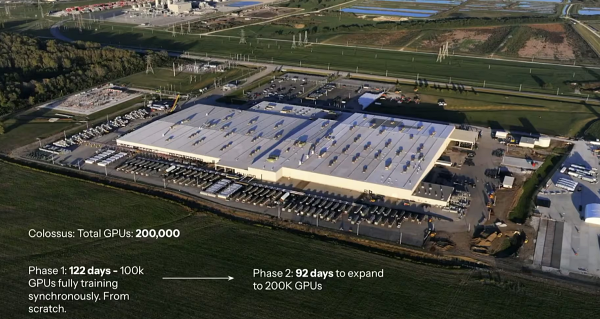
In Memphis, xAI has operated gas turbines since 2024 to supply power to its Colossus data centre. The NAACP has repeatedly raised concerns that xAI operated some gas turbines without permits and pollution controls required by federal law. The NAACP said gas turbines can emit smog-forming substances and hazardous chemicals including formaldehyde, and that such pollutants are linked to asthma and respiratory disease, as well as some cancers.
Communities already bearing a heavy burden of industrial pollution are located around the facility. Researchers at the University of Memphis also found that air pollution worsened "slightly" due to data centre operations, while noting their own analysis was limited.
Memphis is only a prominent example of conflict over gas turbines. In Virginia's 'Data Center Alley', environmental and health issues were raised as gas turbines were used to secure electricity for data centres. A study commissioned by the Piedmont Environmental Council used the U.S. Environmental Protection Agency's COBRA health impact model to analyse the impact of emissions from 8 continuously operating gas turbines at a data centre.
The study estimated the emissions could affect more than 2.5 million people across multiple counties. It also found there could be 3.4 to 6.5 additional premature deaths a year and $53 million to $99 million in health-related damages. It said these are estimates modelled based on emissions, not actual damages or deaths.
Ultimately, SpaceX's in-house production of gas turbine parts is drawing attention as a new supply-chain strategy that could speed up how quickly AI data centres secure power. At the same time, air pollution and community health problems tied to expanding natural gas generation could grow, and an assessment is emerging that AI infrastructure expansion has entered a stage where it must address not only power supply but also environmental and regulatory issues.
 Seung-ah Yoo
ysah@d-today.co.kr
Seung-ah Yoo
ysah@d-today.co.kr