
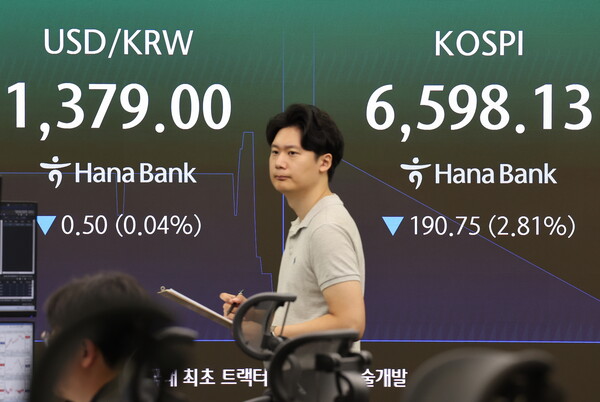
The KOSPI fell more than 3 percent in early trade, sliding to the 6,500 level on worries about a rate hike after hawkish remarks by U.S. Federal Reserve Chair Kevin Warsh. U.S. Treasury yields rose, sending technology and semiconductor shares down and spilling over into South Korean stocks. Samsung Electronics and SK Hynix were also down about 4 percent.
At 9:07 a.m. on Aug. 31, the KOSPI was down 235.35 points, or 3.47 percent, at 6,553.53 from the previous session. The index opened down 175.30 points, or 2.58 percent, at 6,613.58 and extended losses.
In the main board market, foreign investors were net sellers of 177.1 billion won. Institutions also sold 65.6 billion won, while retail investors were net buyers of 217.4 billion won.
Losses were steep among heavyweight chipmakers. Samsung Electronics fell 3.89 percent to 247,000 won, while SK Hynix slipped 4.48 percent to 1,579,000 won.
SK Square fell 4.77 percent and Samsung Electro-Mechanics dropped 5.70 percent. Samsung Biologics and Hyundai Motor were also down 2.36 percent and 2.38 percent, respectively.
KB Financial rose 0.93 percent, while LG Energy Solution was down 0.14 percent, limiting losses compared with others.
The KOSDAQ also fell sharply. At the same time, it was down 32.02 points, or 3.82 percent, at 806.39, slipping to the 800 level.
In the Seoul foreign exchange market, the won was at 1,377.60 per dollar, down 3.40 won from the previous session.
The sharp fall in South Korean stocks was seen as being influenced by a rapid rise in the likelihood of a U.S. rate hike in September after Warsh's Jackson Hole remarks. Selling continued in large South Korean chipmakers as U.S. technology and semiconductor shares moved lower on rate-hike worries.
Han Ji-young (한지영), a researcher at Kiwoom Securities, said Warsh's remarks at Jackson Hole largely stressed in principle the Fed's dual mandate of price stability and full employment. Han said it was appropriate, as before, to continue placing high importance on inflation and employment indicators. Han also said whether semiconductor sentiment and supply-demand conditions can normalize through Broadcom earnings and South Korea's August exports due this week is expected to act as a variable in whether the KOSPI can break above 7,000 points and hold that level.
 Sangyeop Oh
yub@d-today.co.kr
Sangyeop Oh
yub@d-today.co.kr