
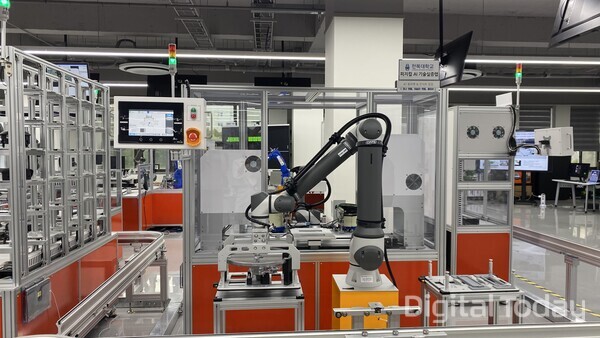
[Jeonju=DigitalToday reporter Seulgi Son] A robot arm picked up a steering wheel and placed it on a transfer device between processes, moving the part to the next cell. Another robot arm picked it up and continued machining and assembly. Autonomous mobile robots (AMRs) moved between cells carrying materials. When a reporter casually stepped into the safety zone in front of a robot cell, an alarm sounded and the moving equipment stopped immediately. The state change was reflected on a digital twin screen on the wall about 0.5 seconds later.
The 'Physical AI Manufacturing Technology Pilot Lab' at Jeonbuk National University visited on Aug. 27 tests technology that adds 'autonomous judgement' to existing automated factories. If existing automation repeats predefined processes, the lab aims to raise it to a stage where equipment recognises abnormal situations and changes work sequences on its own. It has implemented anomaly detection and response recommendations, while technology to directly adjust equipment and restore processes will be developed in the main project.
The pilot lab covers 846 square metres and was built through a proof-of-concept (PoC) project last year at a cost of 6.77 billion won. In the production zone (P zone), which implements real production processes, 9 robot cells are lined up.
When an AMR brings in raw materials, vision equipment checks the condition of the material. Normal material goes through deburring, laser marking, machining, assembly and quality inspection in order, while defective items exit on a separate rail. Researchers explained they configured processes for 3 products, including automotive steering wheels and rearview mirrors.
Kim Soon-tae (김순태), head of Jeonbuk National University's Physical AI Convergence Technology Project Promotion Group, said, "Putting humanoid robots in does not immediately raise factory productivity." He said the goal is for existing equipment to collaborate, coordinate and improve efficiency.
The key is the factory operating system (OS) that enables them to move autonomously rather than the robots' movements themselves. At the pilot lab, robot arms, AMRs, sensors and machining equipment were connected into a single system to share production plans and facility information. When a researcher said, "Show me the A4 process status," an AI agent retrieved production data and displayed the relevant process screen.
Process management was handled by multiple AIs sharing roles. Each cell has an agent by process, and an integrated agent that binds them monitors the overall process. When sensor values move outside a normal range, the process agent detects the abnormality and the integrated agent identifies the affected process and suggests response methods to workers.
But when a problem occurs in one piece of equipment, a person or a higher-level control system still needs to intervene to adjust work sequences in a chain that includes other facilities and logistics robots.
The main Jeonbuk physical AI project aims to raise autonomy to a level where, if an abnormality occurs in one machine tool, it identifies the cause and adjusts the sequence of downstream processes or distributes production to other equipment. It will also develop technology for AI to directly adjust equipment to restore operations and optimise multiple processes together.
Past the production zone and into the innovation zone (I zone), multi-manipulators, mobile dual-arm robots, and motion capture and virtual reality (VR) equipment are gathered in one space. If the P zone replicates actual manufacturing processes, the I zone teaches robots how to use their bodies. It motion-captures human movement, converts it into robot training data, and collects and learns various robot action data. The I zone contains 8 types of equipment, 20 units in total.
In a separate motion-capture room, when a Jeonbuk National University researcher moved both arms with markers attached to the body, a Unitree humanoid from China across the room followed a similar posture. The lab said it uses imported robots that are used as laboratory standards for demonstrations because the project goal is not hardware development but the development of 'action intelligence' that can be applied to various robots.
High-speed cameras installed on the ceiling read human joint movements and changed them to fit a robot body structure, in so-called 'retargeting' technology. The resulting human motion data is converted into robot joint information and video data for training. Motions and exceptional situations that are hard to secure in real environments are supplemented with synthetic data made in Nvidia Isaac Sim.
On other equipment, a person directly moved a dual-arm robot to teach motions such as picking up objects and assembling them. The robot's joint information and camera video were saved as training data. Researchers explained they train robot action models using both the real action data collected this way and simulation data.
Not every demonstration ran smoothly. A reporter tried to experience remote control using VR equipment, but it did not operate immediately. As a site that collects data by operating real equipment, unexpected variables naturally emerged.
Such virtual environments are also used to create data that is difficult to obtain in real factories. This is to train responses to situations that occur infrequently but are important to handle, such as fires or equipment failures. Since accidents cannot be deliberately created in real factories, VR or simulations are used to create exceptional situations and secure response data for people and robots.
Demonstrations also proceeded at factories outside the lab. Jeonbuk National University researchers explained they applied PoC technology last year to 3 Jeonbuk-area auto parts companies, including DH Autolead, Daeseung Precision and Donghae Metal.
At DH Autolead, AMRs were deployed for transport between processes, and at Daeseung Precision, some automation was applied to tasks such as loading and unloading material into machine tools and parts sorting. Researchers said output increased by 7.4 percent and 11.4 percent, respectively.
Unlike last year, when it was at the PoC stage, the project will expand significantly from this year. The Ministry of Science and ICT and NIPA will invest a total of 1.41 trillion won in physical AI research and development in South Gyeongsang and North Jeolla from 2026 to 2030. It will allocate 736.8 billion won to North Jeolla and 676.3 billion won to South Gyeongsang to pursue a total of 35 R&D tasks.
The core of physical AI as seen by the Ministry of Science and ICT is enabling manufacturing equipment to recognise and judge surrounding situations and move on its own. This requires not only software that connects different robots and manufacturing equipment but also data to train on the various situations that occur in real factories. The R&D goal is to move beyond simple automation and make equipment collaborate even in exceptional situations.
Lee Joon-woo (이준우), manufacturing AX PM at NIPA, said, "Physical AI as seen by the Ministry of Science and ICT is not limited to humanoids." He explained that in manufacturing sites where automation has already been achieved to a considerable extent, it is important to make existing equipment and robots intelligent and connect them with each other.
Plans for a domestic physical AI full stack also have a clear direction. While it cannot eliminate all foreign platforms such as Nvidia Isaac Sim or Siemens, it plans to secure and standardise, under state leadership, areas that can be replaced with domestic technology, including the factory OS, AI models and equipment control.
Kim said, "What we ultimately want to make is an 'AI factory manager'," and added, "The goal is to create an environment where AI can operate a factory autonomously."
 Seulgi Son
sageson@d-today.co.kr
Seulgi Son
sageson@d-today.co.kr